

Q4 2026 on Amazon: the complete guide for sellers (dates, news and strategies)
When it comes to sales on Amazon and commercial results, the fourth quarter of the year (Q4) is certainly the most important period, the one that can make the real difference between a successful year and one that falls short of expectations.
As an Amazon seller, then, your job will be to prepare for this phase as well as possible in order to maximise sales opportunities, especially considering the importance of the Christmas holidays and the other events on the calendar for this final part of 2026. But Q4 2026 comes with quite a few new developments compared with last year: new rules on reference prices, a surcharge on fulfilment fees, new obligations on environmental claims and earlier deadlines.
Subscribe to Newsletter
Articles, mini-guides and updates on Amazon world from leading insiders.
In this complete guide we share the most effective strategies and tactics to tackle Q4 with confidence and achieve the best possible results, with dates, costs and rules updated for 2026.
Read also our article Christmas 2026 on Amazon: 10 strategies to sell more
Q4 2026 on Amazon: the essentials
- What Q4 is: the fourth quarter of the year, from October to December, which includes Black Friday, Cyber Monday and the Christmas holidays.
- Key dates: Black Friday on Friday 27 November, Cyber Monday on Monday 30 November, last Prime orders for delivery before Christmas on 22-23 December.
- Deadlines for sellers: inventory at FBA by 21 October (28 October for the United Kingdom) and submission of Lightning Deals and Best Deals by 18 November.
- Costs to consider: the 1.5% fuel and logistics surcharge on FBA fees, the holiday fee in Germany and the United Kingdom (15 October – 14 January 2027) and, for event promotions on Amazon.it, €10 plus 0.5% of promotional sales (capped at €300).
- What’s new in 2026 on prices and policies: new reference price policy from 23 April, environmental claims (ECGT) from 27 September, new dangerous goods questions from 26 October.
Read also our article New Amazon Fuel and Logistics Surcharge: What Changes for European Sellers
Why Q4 is so important
To understand why it is so important to focus on the fourth quarter, it is best to start from the beginning.
Q4 is a practically unique period of the calendar, which for most Amazon sellers is characterised by a significant increase in sales. For many sellers, the sales concentrated between Black Friday and Cyber Monday can account for 25-30% of annual turnover, and missed opportunities are hard to recover.
The credit for this revenue boom goes to the coincidence of a dense series of events eagerly awaited by shoppers, such as the Christmas holidays, Black Friday and Cyber Monday. In the United States, for example, Cyber Week 2025 (the five days from Thanksgiving to Cyber Monday) generated $44.2 billion in online spending (+7.7%). In Italy, according to the Confcommercio-Format Research survey on Black Friday 2025, 70.2% of Italians made purchases during Black Week. Black Friday purchases accounted for 47% of the overall Christmas budget.
For an Amazon seller, all this means an incredible opportunity to increase sales and brand visibility. However, you can be sure that you won’t be the only one who wants to seize it. Your competitors, who are also growing in number, have high expectations for Q4 too. So it is worth being fully aware of the preparatory steps. Let’s discover them together!
Read also our article Amazon extends the Christmas return period: opportunities and strategies for sellers
The dates to mark on your calendar in Q4 2026
Let’s get straight to the point: scheduling the dates correctly allows you to arrive well prepared for every commercial event. Compared with 2024, the deadlines have moved significantly, so don’t rely on old calendars.
| Date | What happens |
|---|---|
| 6-7 October | Prime Big Deal Days (deal submission closed on 23 September) |
| 15 October – 14 January 2027 | Holiday peak fulfilment fee on selected Fulfilment by Amazon orders in Germany and the United Kingdom |
| 21 October (28 for the United Kingdom) | Deadline for FBA inventory to arrive for Black Friday Week |
| 26 October | New compliance questions for four categories of dangerous goods |
| 31 October | Halloween |
| 18 November | Submission deadline for Lightning Deals and Best Deals for Black Friday and Cyber Monday |
| 27 November | Black Friday |
| 30 November | Cyber Monday |
| 22-23 December | Last days to order with Prime delivery before Christmas |
| 24, 25 December and 1 January | Christmas Eve, Christmas Day and New Year’s Day |
| 14 January 2027 | End of the holiday peak fulfilment fee (Germany and the United Kingdom) |
| 31 January 2027 | End of the extended return window |
The end-of-year calendar
As for the events with the most important commercial implications, we have selected three on which to build specially tailored strategies:
- Halloween. It takes place on 31 October every year (in 2026 it falls on a Saturday), the eve of the Christian feast of All Saints. It is an event with a strong folklore element. People dress up, go trick-or-treating and throw costume parties. Sales of related products, food and otherwise, soar as the celebration approaches. So it pays to focus on the weeks leading up to the end of October (and to plan it in good time the following year);
- Black Friday and Cyber Monday. In 2026 they take place on 27 and 30 November. Black Friday falls on the day after Thanksgiving in the United States (celebrated on the fourth Thursday of November). It essentially marks the start of the Christmas shopping season. On Amazon.it, however, the deals last more than four days. In the last two years Black Friday Week lasted about twelve days and ended with Cyber Monday;
- End-of-year holidays. Sales peak with the end-of-year and New Year holidays: Christmas Eve (24 December), Christmas Day (25 December) and New Year’s Day (1 January). A trio characterised by shopping, gifts and celebrations with family, colleagues and friends.

What’s new in 2026: what to know before Q4
The fourth quarter of 2026 opens with several new developments that emerged in recent months. Here are the ones that have the greatest impact on prices, margins and listings:
New reference price policy (from 23 April 2026)
Since 23 April 2026 every reference price shown on a product listing must be verifiable. The List Price (the struck-through list price) must be supported by actual sales at that price on the Featured Offer or by evidence that the price exists, or has recently existed, at another verifiable retailer; otherwise the struck-through price is not shown.
The calculation of the Typical Price is also changing: if you have kept the product on promotion for more than 45 days in the last 90, Amazon considers that discounted price to be your “normal” price. Coupons, Buy X Get Y offers, Subscribe & Save and prices applied during peak events such as Black Friday remain excluded from the recalculation. The consequences for those who do not follow the rules can go as far as removal from the Featured Offer and suspension.
Fuel and logistics surcharge (from 17 April 2026)
Since 17 April 2026 Amazon has applied a temporary fuel and logistics surcharge, calculated on Fulfilment by Amazon fees and not on the selling price: for Europe it is 1.5%. Amazon states that it is in addition to the holiday peak fulfilment fee, which from 15 October 2026 to 14 January 2027 applies to selected orders in Germany (on average €0.27 per item) and the United Kingdom. It must be included in your margin calculations: for a complete overview, see here how to understand all the Amazon selling fees.
Environmental claims and product listings (from 27 September 2026)
Since 27 September 2026 Directive (EU) 2024/825, known as ECGT or EmpCo, has applied; it was transposed in Italy by Legislative Decree 30/2026. Generic claims such as “eco-friendly”, “green” or “sustainable” are considered misleading if you cannot prove the promised environmental excellence. Reread titles, bullet points, descriptions and images and gather documentary evidence. Products manufactured or packaged before 27 September can continue to be sold, as long as customers are properly informed.
Dangerous goods: new questions from 26 October 2026
From 26 October Amazon is introducing new compliance questions for four categories: refrigerators, freezers and air conditioners; shock absorbers and suspension lift kits; markers and writing instruments; pool and spa products. The questionnaire appears the first time you edit the offer: even a small change to a title can trigger it. If you sell in these categories, avoid last-minute changes and keep your documentation ready.
Other useful developments for Q4
- Export with Fulfilment by Amazon: the export programme has been extended to more than 175 new countries, with automatic activation for those already using it. Check legal limits, certifications and the weight and dimension data of your products.
- Images and A+ Content: in 2026 Amazon updated its image rules and removed the option to add alt text in A+ Content and the Brand Story. Check your listings and no longer count on that field for SEO.
- Small non-EU parcels: since 1 July 2026 a €3 duty has applied in Europe to small parcels arriving from non-EU countries, for products worth up to €150. If you ship directly from abroad, include it in your costs.
- Artificial intelligence: AI assistants are increasingly present in the buying process and in account management (for example with the Amazon Selling Partner plugin, currently active in Quick and in beta on Claude for US stores only).
Read also our guide Ultimate Guide to Selling on Amazon North America: Conquer New Markets with ZonWizard!
When to prepare for Q4 if you sell on Amazon
Strategic preparation for Q4 must start well before the arrival of autumn. So, if you haven’t taken matters in hand yet… you’re a little late (but don’t worry, you can still catch up: you’ll find out how in the inventory section).
For the future, we recommend that you start planning your strategy as early as the summer, because you will have plenty of time to analyse past sales data, identify emerging market trends and make informed decisions about which products to promote and how to manage your inventory. Here is a reference calendar:
| When | What to do |
|---|---|
| June – July | Analyse the previous Q4’s sales, check the new policies and costs and choose the products to focus on |
| August – September | Send inventory to FBA (Amazon recommends August and September), prepare listings and content, submit deals within the early windows |
| October | Meet the inbound deadline, prepare campaigns and advertising budgets and start lead generation on your own channels |
| November | Submit deals by 18 November, monitor stock, prices and advertising every day during Black Friday Week |
| December | Manage shipments and customer service up to the Prime cut-off dates, then prepare for returns and sales |
| January | Manage returns and refunds, analyse the results and plan for next year |
Read also our article 75-character Amazon titles: how to prepare for the 27 July 2026 change
What data to assess to prepare strategically for Q4
The first step is to review your products’ performance during the previous year’s Q4. So ask yourself:
- which items sold well?
- were there products that fell short of expectations?
- how much did you really earn, after fees, logistics, advertising and returns?
- at what prices did you sell in the last 90 days and for how many days were you on promotion?
An analysis of this kind is the first step in a process to predict which could be your best sellers for the coming season. Remember, however, that the market is constantly evolving: don’t make the serious mistake of relying exclusively on historical data. Keep an eye on current trends and try to anticipate which products could become popular in the coming months.
Optimise your listings
Once you have identified the products to focus on, it is time to concentrate on optimising your listings. Your product pages must be flawless in both form and substance before the start of the final season of the year:
- High-quality images that accurately represent the product, in line with the rules updated in 2026.
- Detailed, clear and convincing descriptions that highlight the benefits and answer shoppers’ most common questions.
- Keywords: do thorough research and optimise your listings for the most relevant terms, including seasonal keywords such as “gift idea”. Don’t put promotional phrases such as “Black Friday” in the title: they are not allowed.
- Complete attributes: AI-based search engines and shopping assistants rely on listing data.
- Compliant claims: avoid generic environmental claims without evidence (ECGT directive).
- Reviews: they play a crucial role, especially at Christmas, because many people are buying gifts and want a purchase that won’t embarrass them.
If you have new products or products with few reviews, consider launching promotional campaigns or using Amazon’s Vine programme. It can help you generate your first authentic reviews conveniently and quickly. For existing products, on the other hand, answering customer questions promptly and actively managing negative reviews shows your commitment to customer satisfaction.
Read also our article Amazon Reviews 2026: ZonWizard Guide to Strategies, Policies, and Best Practices for Sellers
Inventory management in Q4
Inventory management is one of the most critical aspects of preparing for the fourth quarter. Running out of stock during the peak trading period? It can mean not only losing sales immediately, but also damaging your products’ ranking in Amazon searches for the following months. On the other hand, excess inventory can lead to high storage costs and tied-up capital.
That is why your goal must be to find the right balance. Start from your sales forecasts and always keep a safety margin for unexpected peaks in demand. Amazon recommends keeping at least 28 days of inventory based on historical demand.
In particular, if you use Fulfillment by Amazon (FBA), remember that fulfilment centres focus on receiving inventory in September and October and on processing orders in November and December: that is why delivery slots are limited and the inbound deadline for Black Friday was 21 October (28 October for the United Kingdom).
If you have missed the inbound deadline
It’s not the end of the world, but you need to change approach:
- give priority to best sellers
- handle via FBM (direct shipping) the products that won’t arrive in time
- communicate realistic delivery times
- don’t submit deals you can’t sustain.
Capacity, AWD and fees
If you expect high volumes you can ask Amazon to expand your space with the Capacity Manager feature (an offer with a maximum reservation fee, no upfront payment, and performance-based credits that can offset up to 100% of the fee), or use Amazon Warehousing and Distribution (AWD), which in 2026 does not charge storage fees from 1 October to 31 December for eligible inventory in European centres. Also watch out for the low-inventory-level fee. Amazon recommends bringing inventory into the network at least four weeks ahead of events.
Finally, it is always a good idea to keep a daily eye on Amazon’s communications, especially those on restrictions or deadlines for sending inventory.
Discover ZonWizard’s services for improving inventory management!
The importance of managing stock
If you want to prepare your warehouse as well as possible for the fourth quarter, our advice is to start replenishing stock straight away, with additional shipments compared with your usual routine for the rest of the year. The risk of bunching up shipments just before Q4 is in fact that of sending boxes that Amazon won’t be able to process in time. The marketplace’s logistics are very effective, but in a peak period there may not be enough hours to handle inbound with the right timeliness.
Are you really making a profit?
See your true net margin on every order with ZonWizard's profit analytics.
Learn MorePricing for sales in the fourth quarter of the year
Another key element is your pricing strategy, that is, the strategy for managing prices. Some sellers take the opportunity of Q4 to raise prices and take advantage of higher demand. It is not a strategy we recommend always following (quite the opposite), and in 2026 it is even riskier. It is important to strike a balance between profitability and competitiveness:
- Monitor competitors’ prices and adapt your strategy in real time; automatic repricing tools help you stay competitive without sacrificing margins, as long as you always set a minimum price linked to your real margin.
- Don’t inflate list prices: with the new policy the struck-through price must be verifiable and Amazon monitors price history. When you announce a reduction, the reference price is the lowest applied in the previous 30 days (Omnibus Directive, transposed in Italy by Legislative Decree 26/2023).
- Beware of prolonged promotions: keeping a product discounted for more than 45 days in the last 90 lowers your “typical” price. For short promotions, favour coupons, Buy X Get Y, Subscribe & Save and peak events, which do not affect the recalculation.
- Include all costs in your margin: fees, logistics, the fuel and logistics surcharge, any holiday fee, promotion costs and advertising.
A simple example: a €40 product with a net margin of 20% is worth €8 per unit. With a 15% discount (€6 less) and assuming a 15% referral fee, the margin drops to less than €3, even before counting advertising, surcharges and returns.
Read also our article Guide to Amazon Product Bundles
Promotions, a very important marketing tool
Promotions are a marketing tool at your disposal to win a significant share of the market in Q4. Your task will therefore be to carefully plan deals for key events such as Black Friday and Cyber Monday, without limiting yourself to these dates alone. For event promotions on Amazon.it in 2026:
- the formats are Best Deal, Lightning Deals and Prime exclusive discounts. The latter now require a minimum product rating of 3.5;
- deal submission for Black Friday Week closes on 18 November;
- the fee is €10 per promotion plus 0.5% of promotional sales, capped at €300.
To maximise the benefits, consider:
- launching exclusives for Amazon Prime customers
- running Lightning Deals designed to create a sense of urgency.
Also remember that promotions don’t necessarily have to translate into very high discounts. You can also offer:
- product bundles
- free gifts
- free shipping (or Prime availability) to encourage purchases.
Advertising in Q4
Advertising on Amazon becomes even more important in the last quarter of the year. With increased traffic on the platform, a well-planned advertising strategy can make the difference between going unnoticed and gaining significant visibility. Bear in mind that the cost per click during peak events can even triple.
A good strategy could be to gradually increase your budget as you approach the peak period, separating the event budgets from the ordinary ones, and to carefully monitor campaign performance, focusing on:
- products with the best margins
- products that have proven to convert well in the past.
With the new price policy, moreover, if your listing loses its struck-through price the conversion rate may fall. Review bids and budgets for the ASINs affected.
Not just Amazon: bringing in traffic from outside
Q4 is also the time to work on external channels. Social media, your website’s newsletter and campaigns on other platforms help you reach shoppers who can then choose Amazon or your e-commerce site. Remember that Amazon does not provide customers’ addresses and does not allow marketing through the marketplace messaging. Promotional emails should only be sent to your website’s contacts, with their consent. And if you sell on your own website, since 19 June 2026 you must have the digital withdrawal function active (art. 54-bis of the Italian Consumer Code).
Read also our article Amazon Ads and Agentic AI: all the unBoxed 2026 highlights for sellers
Customer service: better review its procedures
Since we are talking about the essential building blocks of a good Q4 strategy, it is time to stress the importance of customer service once again. With the expected increase in sales, it is very likely that the following will also increase:
- support requests
- product questions
- returns.
Between Black Friday and Christmas, customer contacts can increase by 200-300%. That is why it is essential to have adequate resources:
- answer customer questions promptly
- handle problems proactively
- communicate delivery times clearly (last Prime orders: 22-23 December)
- be generous with your return policies during the Christmas period.
These are all elements that will influence your reputation in the months to come too! Good customer service is not just a cure-all for avoiding negative reviews. It can also turn occasional buyers into loyal customers.
Read also our article How to keep the Amazon account active during the holiday season: the platform’s official recommendations
Think about post-Q4 too!
Don’t make the common mistake of limiting your horizon to 31 December. The fourth quarter is an exceptional opportunity not only to increase immediate sales, but also to build long-term relationships with customers. On Amazon this means working on:
- service quality
- reviews
- if you are enrolled in Brand Registry, tools such as the Store and brand followers.
Be careful: Amazon restricts promotional content in parcels and requests to move to other channels. So check its policies before including materials in your shipments. On your own website, on the other hand, you can invite customers to sign up to your mailing list or follow you on social media.
Also prepare for the post-holiday period from a logistics point of view:
- Returns: an increase in returns right after Christmas is quite likely and the extended return window closes on 31 January 2027. Make sure you have an efficient process.
- Reimbursements: claim windows don’t send reminders. In practice, inbound discrepancies can be reported for about five months, warehouse losses and damage have 60 days, and returns and removals from 60 to 120 days depending on the case.
- Sales: for the 2027 winter sales in Italy, the start date indicated for most regions is 2 January, but some associations have asked for it to be moved: check the calendar for your region.
- Momentum: launch start-of-year promotions and focus on the most relevant products for the new season. It could be a good way to start the new year in the best possible way.
Read also our article FBA Reimbursement Software: how to recover every euro owed from Amazon
Quick checklist for Q4 2026
- Check the deadlines: inbound (21 and 28 October), deals (18 November), last Prime orders (22-23 December).
- Check that List Prices are supported by actual sales or by other retailers’ prices.
- Reread titles, bullet points and images: no generic environmental claims and no promotional phrases in the title.
- Avoid last-minute changes in the dangerous goods categories.
- Keep at least 28 days of inventory and consider FBM for late products.
- Include the fuel and logistics surcharge, holiday fees and promotion costs in your margin calculation.
- Only submit deals with sufficient margin and stock.
- Set separate advertising budgets for the event and review bids and budgets for ASINs without a struck-through price.
- Strengthen customer service and prepare for January returns and reimbursements.
Read also our guide Selling toys on Amazon: the complete guide [2026]
Frequently asked questions about Q4 on Amazon
What is Q4 on Amazon?
It is the fourth quarter of the year, from October to December. For most sellers it is the period with the highest sales, thanks to events such as Black Friday, Cyber Monday and the Christmas holidays.
What are the key dates of Q4 2026?
Black Friday on Friday 27 November, Cyber Monday on Monday 30 November and last Prime orders for delivery before Christmas on 22-23 December. Inventory had to arrive at FBA by 21 October (28 October for the United Kingdom) and deals must be submitted by 18 November.
By when do I need to send inventory to FBA for Black Friday 2026?
By 21 October 2026 for the European Union and 28 October for the United Kingdom. If you have missed the deadline, consider handling late products via FBM.
Which 2026 changes have the biggest impact on Q4?
The new reference price policy (from 23 April), the fuel and logistics surcharge on Fulfilment by Amazon fees (from 17 April, 1.5% in Europe), the ECGT directive on environmental claims (from 27 September) and the new dangerous goods questions (from 26 October).
How does the struck-through price work after the new policy?
The List Price is only shown if it is supported by actual sales at that price on the Featured Offer or by evidence of the price at another verifiable retailer. Otherwise the struck-through price does not appear.
How much does it cost to take part in event promotions on Amazon.it?
For the 2026 event promotions, the fee is €10 per promotion plus 0.5% of promotional sales, capped at €300. Always check the updated costs in Seller Central.
When should you start preparing for Q4?
As early as the summer: June-July to analyse data and choose products, August-September to send inventory and prepare listings and deals.
What should you do after Q4?
Manage returns (the extended return window closes on 31 January 2027) and reimbursements, analyse the results and plan promotions and inventory for the new season.
Read also our article How to prevent tax management errors selling on Amazon
Get to Q4 knowing how much you really earn
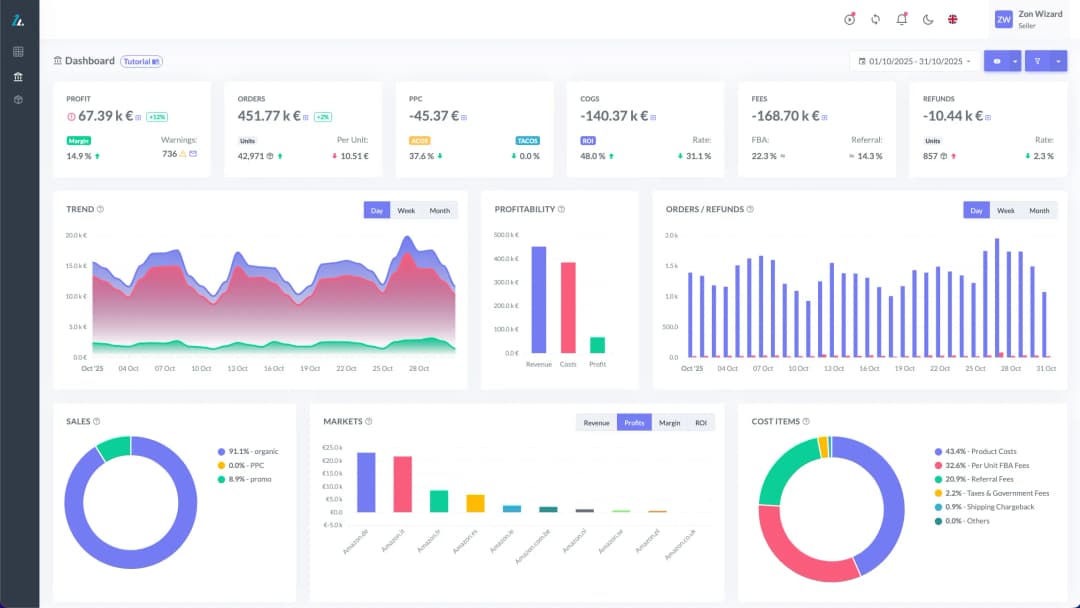
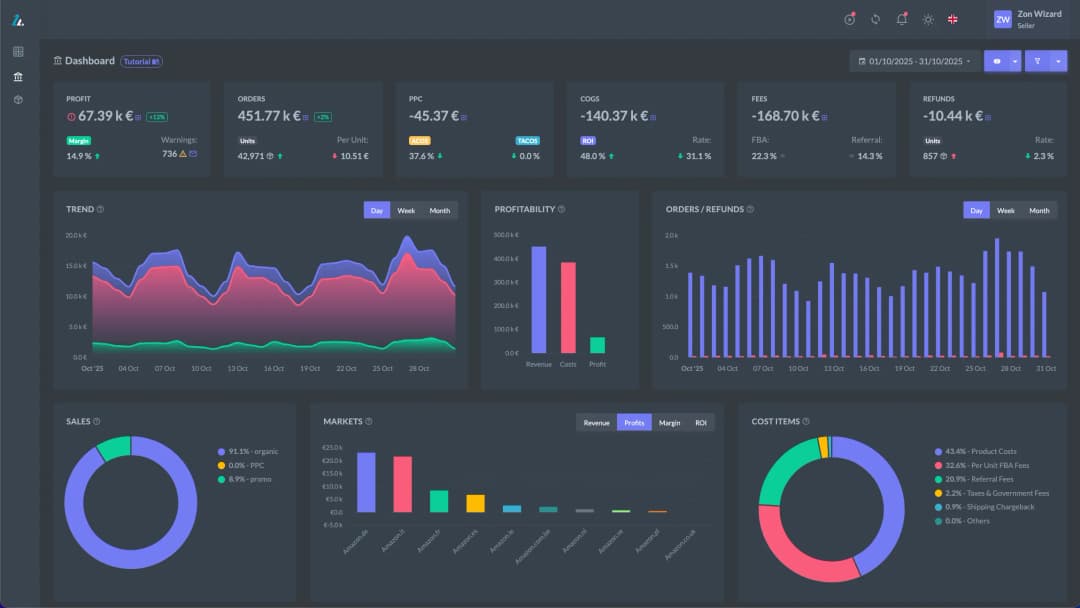
With new fees, surcharges and pricing rules, margin is even more important than turnover. ZonWizard helps you monitor margins, fees and net profit in a single dashboard. Try it free for 30 days, no credit card required.
Know your real Amazon profit
Track margins, fees and net profit in one clear dashboard with ZonWizard.
Learn MoreLoading…

Selling with PrestaShop: an introductory guide for those starting from scratch
When people decide to open an online store, the names that come up most often are usually Amazon and Shopify. But there is another route, one geared towards full control of your own store: PrestaShop. PrestaShop is in fact one of the most widely used e-commerce platforms in Europe, chosen by hundreds of thousands of…
October 6th, 2026

Selling on multiple channels profitably: the practical guide to getting started!
Selling only on Amazon is a great starting point, but today most sellers who really want to grow are looking at multichannel selling: eBay, Shopify, WooCommerce, PrestaShop, and perhaps several Amazon marketplaces at once. The potential is huge. More channels mean more customers reached, less dependence on a single algorithm and steadier revenue.
October 6th, 2026
Ready to transform your business?
Start your free 30-day trial today, setup takes just a few minutes. No credit card required, cancel anytime.