

Selling with PrestaShop: an introductory guide for those starting from scratch
When people decide to open an online store, the names that come up most often are usually Amazon and Shopify. But there is another route, one geared towards full control of your own store: PrestaShop.
PrestaShop is in fact one of the most widely used e-commerce platforms in Europe, chosen by hundreds of thousands of online stores. Yet it remains less well known than other solutions among people approaching online selling for the first time.
Subscribe to Newsletter
Articles, mini-guides and updates on Amazon world from leading insiders.
In this guide we want to close that gap by sharing with all our readers some information that will help you understand
- what PrestaShop is
- what it is for
- when it makes sense to choose it
- how to fit it into a broader sales strategy (perhaps alongside Amazon, eBay or other channels) without turning it into yet another system disconnected from the rest of the business.
What is PrestaShop?
PrestaShop is an open source e-commerce platform of French origin that lets businesses create and manage their own online store. What sets it apart most from solutions like Shopify is precisely its open source nature. The core software is free and the code is fully modifiable. Users don’t pay a monthly fee to rent the platform: all it takes is installing the system on your own hosting.
Naturally, all this translates into more freedom and fewer constraints, but in exchange for slightly more demanding technical management compared with a fully hosted platform. Choosing between PrestaShop and Shopify is therefore one of the most decisive choices anyone launching or migrating an online store has to make, because the two approaches are opposites: a turnkey platform on one side, a tailor-made platform on the other.
Read also our article Claude Sonnet 4.6 on Amazon Bedrock: what changes for sellers
What PrestaShop is for and who uses it
PrestaShop was built to run a proprietary online store, with full ownership of the catalog, customer data and sales process. So this is not a marketplace like Amazon or eBay, where you join an existing storefront populated by millions of buyers, but your own shop, living on your own domain and reflecting your company identity in every respect.
It is an e-commerce solution used by more than 250,000 online stores worldwide, with particularly strong adoption in Europe among:
- SMEs and sellers with large catalogs, who need to manage many products, variants and price lists in a structured way
- Multilingual, multi-country businesses, selling in different markets with different currencies, languages and tax regimes
- Companies with in-house technical skills (or a development partner), who want to customize the store experience in depth without the limits of a standard theme
- Brands that want to reduce their reliance on per-transaction fees typical of some SaaS platforms, accepting in return the responsibility of managing hosting and maintenance
As we partly mentioned already, it is a robust and customizable tool. For that very reason, it is less immediate to use than Shopify. In short, it is not the best choice for those looking for the fastest possible launch with minimal technical effort. Rather, it suits those willing to invest a little more in exchange for long-term control and flexibility.
Read also our article Amazon’s artificial intelligence doesn’t look at the rankings (and for sellers that’s very interesting!)
When it makes sense to choose PrestaShop (and when it doesn’t)
With all that said, there are situations where choosing PrestaShop can be worthwhile and appropriate, and others where other solutions are preferable.
Simplifying a little, we can agree that PrestaShop makes sense if:
- You want to build a brand you own, with a store that reflects your identity and doesn’t share space with direct competitors, as happens on marketplaces.
- You have a large, complex product catalog, with many variants, categories or price lists that differ by market.
- You sell (or want to sell) in several European countries, taking advantage of the platform’s native multilingual and multi-currency features.
- You want to reduce your reliance on recurring fees tied to sales volume, accepting in return a minimum of technical management.
- You already have (or can build) in-house technical skills or a trusted partner for site maintenance, updates and security.
On the other hand, PrestaShop may make less sense if:
- You want to launch very quickly without dealing with any technical aspect: in that case a fully hosted platform can be a faster starting point.
- Your main goal is to sell on marketplaces already crowded with customers (Amazon, eBay), where a proprietary shop plays a complementary role, not a replacement one.
- You have neither the time nor the budget for technical maintenance, which with a self-hosted platform remains your responsibility, either directly or through a provider.
It is no coincidence that many successful businesses don’t frame it as Amazon or PrestaShop. In short, they prefer to use them together: the marketplace to capture existing demand and generate volume, and the proprietary shop to build a direct relationship with the customer, higher long-term margins and independence from third-party rules.
Are you really making a profit?
See your true net margin on every order with ZonWizard's profit analytics.
Learn MoreWhy a proprietary shop can give you something more than marketplaces alone
Those who sell exclusively on marketplaces are, in effect, renting. They don’t own their customer data, they are subject to policies and algorithms that can change at any moment, and they pay sales fees that hit the margin of every single order directly. A PrestaShop store partly reverses this logic:
- The customer data is yours, and you can build remarketing, email marketing and loyalty strategies that are simply not available on a marketplace.
- The margin per sale is generally higher, because there is no fixed fee on sales as there is on a marketplace.
- You have full control over the shopping experience, from design to logistics to promotions.
Of course, there is also a flip side. For example, you have to generate traffic yourself. A marketplace brings its own customers, whereas a proprietary shop needs an acquisition strategy (SEO, advertising, social, email) to get visitors. That’s why, in most cases, PrestaShop works better as a complementary channel to marketplaces rather than as an exclusive alternative, especially in the early stages.
Read also our article How to sell on Amazon USA: the complete guide for European sellers
The most common mistake when starting from scratch with multiple channels
Those who decide to open a PrestaShop store alongside Amazon or eBay often make the same mistake: they manage the two tools as if they were completely separate. Hence:
- misaligned catalogs
- inventories managed on different spreadsheets
- margins calculated channel by channel without an overall view.
Over time, the result is what we have already described in other guides on this blog:
- risk of overselling
- hours lost cross-checking data
- reorder decisions made blindly because nobody has the full picture of actual sales.
Adding a sales channel (whether PrestaShop, Shopify or eBay) only makes sense if, from day one, you integrate it into a single control system. In other words, you shouldn’t add it as yet another dashboard to check separately. But how do you do that?
How ZonWizard helps those who sell (also) with PrestaShop
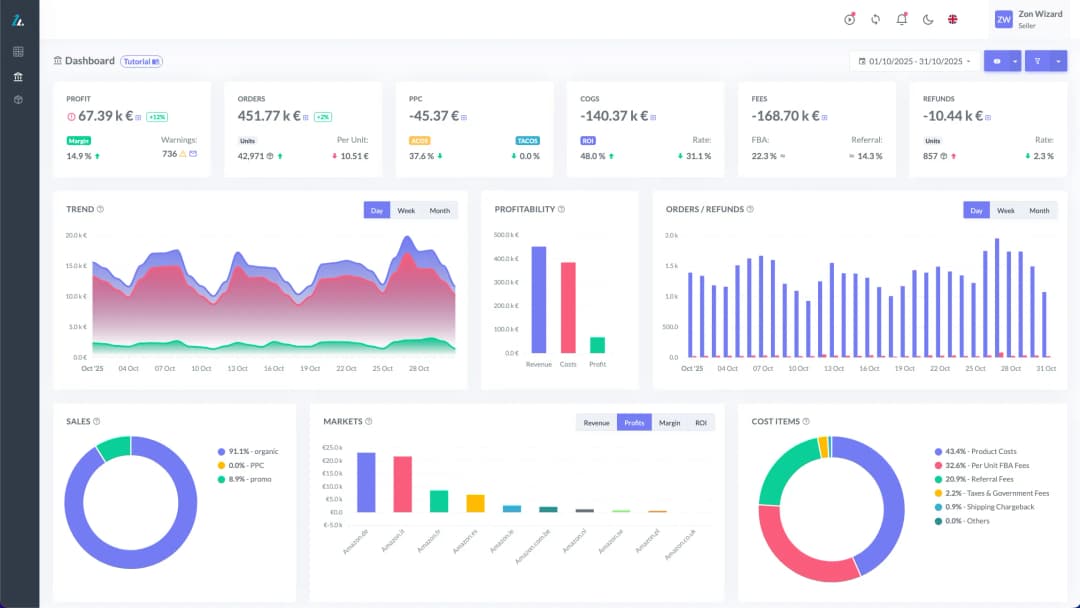
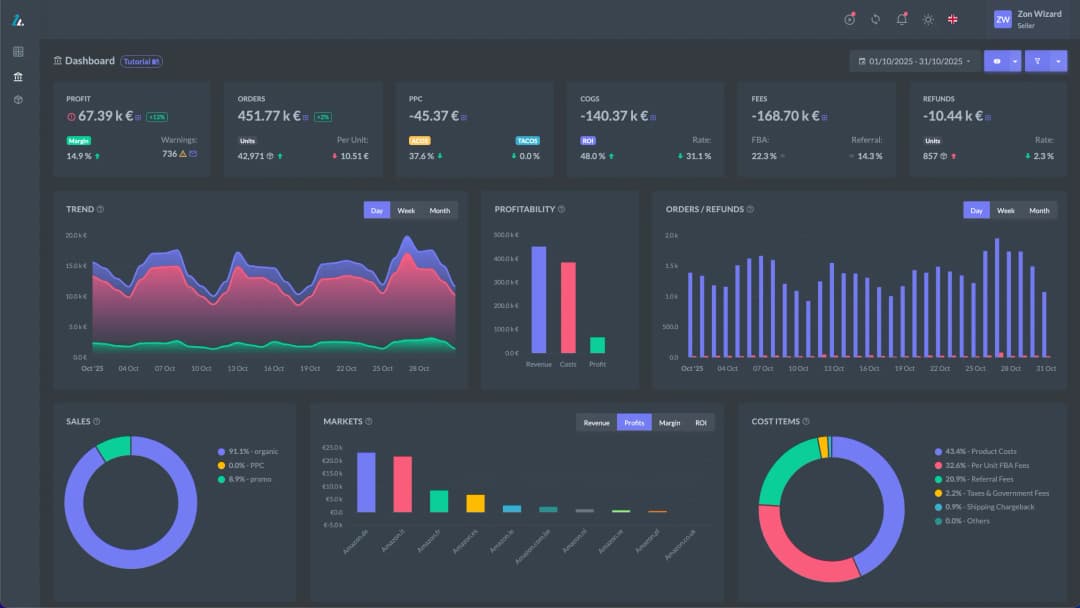
This is where ZonWizard comes in. Among the available marketplace integrations there is also PrestaShop, alongside Amazon, eBay, Shopify and WooCommerce. Once your PrestaShop store is connected, its sales data flows into the same dashboard that also gathers your other channels. This way you can:
- See the sales and margins of your PrestaShop shop together with those of Amazon, eBay or the other connected channels, instead of checking them separately.
- Keep inventory aligned between your proprietary store and the marketplaces, reducing the risk of overselling or of phantom stock on one channel while the item is sold out on another.
- Manage tax and VAT reports centrally, even when you sell in several countries at the same time across your own store and marketplaces.
- Get a single view of real profit by product and by channel, taking into account the different costs, advertising and margins of your own shop and the marketplaces.
In practice, ZonWizard lets you treat PrestaShop as part of a coherent multichannel sales strategy: a system in which every channel contributes to one single control picture of sales, stock and profits.
Read also our article Amazon’s fight against counterfeiting: 15 million fake products blocked in 2025
PrestaShop FAQ
Is PrestaShop free?
The core software is open source and free to download. The actual costs concern hosting, any premium themes and modules and, if needed, custom development.
Is PrestaShop suitable for beginners with no technical skills?
It can be used by beginners too, but it is generally considered less immediate than platforms like Shopify. That’s why many rely on a small team or a technical partner, at least during the launch phase.
Is it worth opening a PrestaShop store if I already sell on Amazon?
Yes, often as a complement: Amazon brings volume and immediate visibility, while a PrestaShop store builds a direct relationship with the customer and potentially higher margins, provided the two channels are managed in a coordinated way.
Can PrestaShop be connected to the same tools used for Amazon?
Yes, tools like ZonWizard integrate PrestaShop together with Amazon, eBay, Shopify and WooCommerce, offering a single dashboard for sales, inventory and margins across all channels.
Know your real Amazon profit
Track margins, fees and net profit in one clear dashboard with ZonWizard.
Learn MoreLoading…

Selling on multiple channels profitably: the practical guide to getting started!
Selling only on Amazon is a great starting point, but today most sellers who really want to grow are looking at multichannel selling: eBay, Shopify, WooCommerce, PrestaShop, and perhaps several Amazon marketplaces at once. The potential is huge. More channels mean more customers reached, less dependence on a single algorithm and steadier revenue.
October 6th, 2026

Overselling on Amazon and marketplaces: how to avoid it with a synchronised inventory
Overselling is the harmful practice of selling a product you no longer actually have in stock. It is, to all intents and purposes, one of the most feared risks for anyone selling online across multiple channels. And, as we will see, it often happens far faster than you might imagine. Let’s picture a typical scenario.…
October 6th, 2026
Ready to transform your business?
Start your free 30-day trial today, setup takes just a few minutes. No credit card required, cancel anytime.