

Selling on multiple channels profitably: the practical guide to getting started!
Selling only on Amazon is a great starting point, but today most sellers who really want to grow are looking at multichannel selling: eBay, Shopify, WooCommerce, PrestaShop, and perhaps several Amazon marketplaces at once.
The potential is huge. More channels mean more customers reached, less dependence on a single algorithm and steadier revenue.
Subscribe to Newsletter
Articles, mini-guides and updates on Amazon world from leading insiders.
That said, without a clear method, multichannel selling can turn into chaotic management that eats away at the very margins it should be growing.
In this guide we’ll look at how to start selling on multiple channels in a sensible, profitable way. We’ll cover:
- where to start
- which mistakes to avoid
- how to keep real costs under control
- why you should coordinate your channels instead of running them as separate silos.
Why selling on multiple marketplaces pays off (if done right)
Right from the start of this long guide, it’s worth remembering that diversifying your sales channels can bring benefits that are often decisive for a company’s growth, such as:
- Lower risk. If an account is suspended, an algorithm changes or fees go up on one marketplace, you don’t depend on a single source of revenue.
- Access to different customer pools. People who buy on eBay aren’t always the same audience as those who buy on Amazon or on your own shop. Each channel has its own audience and its own positioning.
- More control over your brand. Your own shop (Shopify, WooCommerce, PrestaShop) lets you build a direct relationship with customers, collect first-party data and not depend entirely on the rules of a third-party marketplace.
- Economies of scale on logistics and purchasing. By selling more overall, you can negotiate better terms with suppliers and carriers.
The flip side, however, is that every extra channel adds operational complexity. You have to manage orders and prices, keep track of inventory and invoicing, and make decisions on returns and advertising. And if this complexity isn’t governed with the right planning, management time and costs risk growing faster than revenue, cancelling out the advantage of diversification.
Also read our guide Amazon inventory management: a guide to warehouse optimisation
Where to start: our 6-step guide
Here are some of the main steps we recommend to sell effectively on multiple channels, maximising profit and keeping risk at bay.
Choose the right channels for your product, not every possible channel
You don’t need to be everywhere from day one. Look at where your audience really is. A niche B2C product may perform better on Amazon and on your own shop. Collectibles or specific spare parts often find fertile ground on eBay. Expanding too fast, before you’ve built solid processes on one channel, is one of the most common mistakes among beginners.
Align catalogues, prices and content before adding channels
Before connecting a new marketplace, make sure product listings, images and prices are consistent. Price discrepancies between channels confuse customers. They can also cause problems with some marketplaces’ policies (Amazon above all) and make it harder to calculate real margins.
Are you really making a profit?
See your true net margin on every order with ZonWizard's profit analytics.
Learn MorePlan your logistics: FBA, FBM or in-house fulfilment
Decide from the outset how you’ll handle shipping on each channel:
- through Amazon FBA
- fulfilling orders yourself (FBM)
- with a mix of the two, combined with your own warehouse for the other channels.
This choice has a direct impact on margins, delivery times and, as we’ll see, on managing stock shared across channels.
Also read our article Claude Sonnet 4.6 on Amazon Bedrock: what changes for sellers
Calculate the real margin channel by channel, not just revenue
One of the most dangerous mistakes in multichannel selling is looking only at gross revenue. Every marketplace has a different cost structure, including
- selling fees
- storage and shipping costs
- any advertising costs
- VAT and taxes that vary from country to country.
A channel that generates lots of revenue but with thin margins can be worth less, in terms of real profit, than a smaller but more profitable channel.
Automate accounting and tax from the start
Selling on multiple marketplaces and in multiple countries often means dealing with different VAT regimes (especially in Europe, with the OSS thresholds). Handling this manually, channel by channel, quickly becomes unsustainable as sales volume grows. Automating tax data collection and reporting from the start saves you from having to clean things up later, when volumes are already high.
Track advertising by channel, not just in aggregate
If you invest in Amazon Advertising, Google Ads or Meta Advertising to drive sales across your channels, it’s essential to connect that data to the real margin of each product and channel. A product that seems to perform well on revenue may actually have an insufficient ROAS on a specific channel, and so be quietly eroding your profit.
Also read our article FBA or FBM: how to calculate the optimal stock level
How to coordinate your channels effectively
This brings us to the heart of this guide: selling on multiple channels doesn’t mean running several separate stores, but one single business with multiple touchpoints with the customer.
If each marketplace is managed with disconnected tools, spreadsheets and processes, you multiply errors instead of profits. The most frequent problems in this scenario are:
- Misaligned inventory, with the risk of overselling on one channel while another wrongly shows availability
- A partial view of margins, because each platform only shows its own numbers, with no consolidated picture
- Fragmented tax reporting, with hours lost cross-checking data from different exports for the VAT return
- Reorder decisions disconnected from real demand, because no one has an aggregated view of sales across all channels together.
The solution is certainly not to give up on diversification. Rather, it’s to set up from the start a system that connects all your sales channels. That way you’ll always have a single source of truth on sales, margins, stock and taxes.
Also read our article What is ROI and how is it calculated?
How ZonWizard helps you coordinate multichannel selling profitably
At ZonWizard we designed our platform precisely to solve this problem and, thanks to the integrations with the main marketplaces, you can now connect in just a few minutes:
- Amazon Europe and Amazon North America
- eBay
- Shopify
- WooCommerce
- PrestaShop
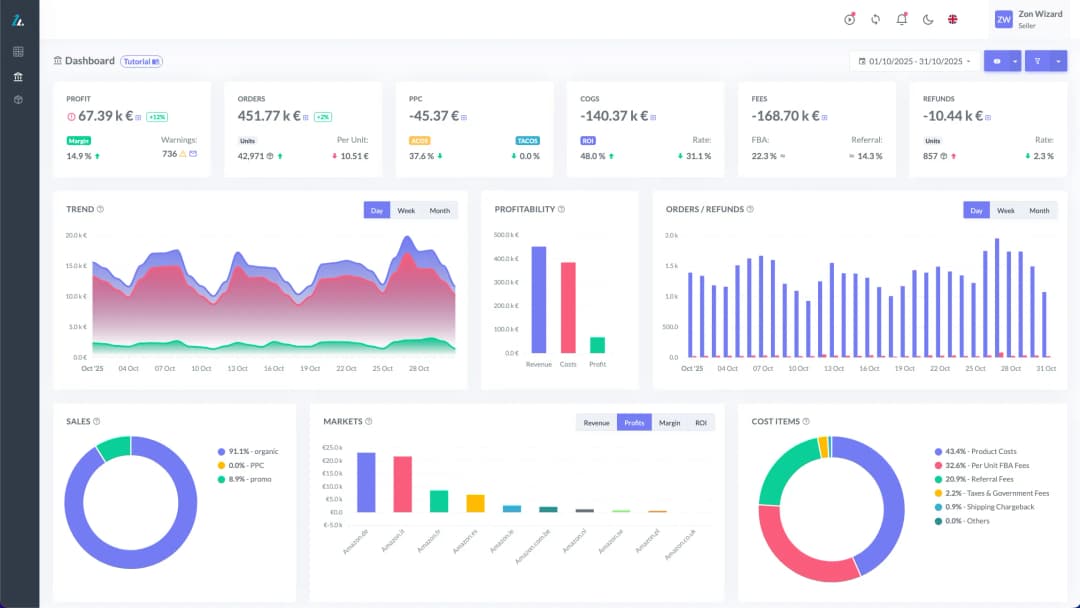
Once connected, all your sales data flows into a single dashboard, giving you the consolidated view we talked about. No more separate spreadsheets to cross-check by hand, just one place to monitor your entire multichannel business. You can also connect several accounts to the same profile (useful if you manage multiple brands or regional marketplaces), with the data aggregated consistently.
On the three fronts we covered in this guide, ZonWizard offers three dedicated tools:
- Accounting Tool. It simplifies tax management and generates accurate VAT reports for every channel. You avoid the manual work that selling across multiple countries and platforms normally requires.
- Profit Tool. Useful for seeing the real margin after fees, advertising costs and cost of goods sold, channel by channel and product by product. All of this instead of reasoning only on gross revenue.
- Inventory. Essential for keeping stock balanced across all connected channels and avoiding both stockouts (lost sales) and overselling (cancelled orders).
To complete the picture, ZonWizard also lets you connect your Amazon Advertising, Meta Advertising and Google Ads accounts. In short, you can read the impact of advertising directly alongside the real margins of each channel, instead of assessing it in isolation from the rest of the business.
Frequently asked questions about multichannel selling
Which channel should you start with for multichannel selling?
There’s no single answer: it depends on the product and the target audience. In general, it’s best to consolidate your processes on a first channel (often Amazon) before expanding to eBay or your own shop.
How do you avoid losing margin when selling on multiple marketplaces?
By calculating the real margin per channel, not just revenue, taking into account fees, logistics costs, advertising and the taxes specific to each platform and country.
Do you need software to manage multiple sales channels?
It’s not mandatory, but it becomes almost indispensable past a certain order volume: without a tool that centralises sales, stock and tax data, the time lost cross-checking information grows faster than revenue.
Can ZonWizard manage accounting, profit and inventory for multiple marketplaces together?
Yes: by connecting Amazon (Europe and North America), eBay, Shopify, WooCommerce and PrestaShop, ZonWizard aggregates the sales, margins and stock of all your channels in a single dashboard, with dedicated tools for accounting, profit and inventory.
Know your real Amazon profit
Track margins, fees and net profit in one clear dashboard with ZonWizard.
Learn MoreLoading…

Selling with PrestaShop: an introductory guide for those starting from scratch
When people decide to open an online store, the names that come up most often are usually Amazon and Shopify. But there is another route, one geared towards full control of your own store: PrestaShop. PrestaShop is in fact one of the most widely used e-commerce platforms in Europe, chosen by hundreds of thousands of…
October 6th, 2026

Overselling on Amazon and marketplaces: how to avoid it with a synchronised inventory
Overselling is the harmful practice of selling a product you no longer actually have in stock. It is, to all intents and purposes, one of the most feared risks for anyone selling online across multiple channels. And, as we will see, it often happens far faster than you might imagine. Let’s picture a typical scenario.…
October 6th, 2026
Ready to transform your business?
Start your free 30-day trial today, setup takes just a few minutes. No credit card required, cancel anytime.