

E-commerce 2026: instalment payments, tighter European controls and customer service at the heart of the shopping experience
Three recently published studies, coming from different fields, together give a sharp picture of where e-commerce is heading:
- consumers are paying in increasingly flexible ways
- the European Union is tightening controls on goods arriving from outside its borders
- customer service confirms itself as the most delicate factor in e-commerce. On its own, in fact, it can build or destroy trust in an online shop.
We have tried to take stock of these different analyses, to draw a few useful conclusions for anyone selling online.
Subscribe to Newsletter
Articles, mini-guides and updates on Amazon world from leading insiders.
Buy Now, Pay Later is no longer a niche
According to a survey carried out by Experian on a sample of more than 1,000 consumers, 43% of respondents say they have used or intend to use “Buy Now, Pay Later” (BNPL) instalment payment plans for their purchases. The figure is more than double the 20% recorded a few years ago.
According to the study, BNPL adoption also cuts across population groups traditionally not associated with this tool. More than half of consumers aged between 25 and 54 said they use or want to use BNPL. And, in a finding that debunks a fairly widespread cliché, higher incomes appear slightly more inclined to use these plans than lower ones, not the other way round.
The reasons given by the consumers surveyed mainly concern
- managing the household budget
- the absence of interest when payments are made on time
- ease of use at checkout.
In its report Experian points out that some consumers remain exposed to the risk of missed payments and penalties. This weighs above all on consumers of intermediate working age, who are more exposed than the very young and the over-65s.
For anyone selling online, there is one takeaway. BNPL is no longer a tool for a niche or for those who struggle to access traditional credit. Rather, it should be seen as a payment option that a substantial share of customers now expects. Especially, of course, during peak periods such as the holidays.
Not offering it at checkout today probably means leaving a share of conversions on the table.
Read also our article How to sell on Amazon USA: The Complete Guide for European sellers
The European Union tightens controls on parcels arriving from abroad
At the opposite end of the chain, that of cross-border logistics, on 20 July the European Commission published its annual report on controls of products entering the single market. The numbers show the now enormous scale reached by non-EU e-commerce. Consider that in 2025 six billion items were released for free circulation, almost triple the 2022 figure, and 97% of incoming shipments come precisely from online commerce. More than 91% of these arrivals fall into the category of so-called “low-value consignments”, which according to the Commission’s own report represent a volume “far beyond what customs and market surveillance authorities can handle with traditional methods“.
The checks carried out in 2025 covered around 387,600 items. Just over half ended with a suspension pending further verification. About 58,000 products were definitively rejected. The most useful figure for those working in e-commerce, however, is another one. According to the Commission’s investigation, more than 60% of products bought online from outside the EU (including toys, electronics, cosmetics, personal protective equipment and food supplements) does not meet the safety and compliance requirements demanded by the European market. In the cosmetics sector alone, 65% of the products sampled turned out to be non-compliant. For personal protective equipment the non-compliance rate rises to 60%.
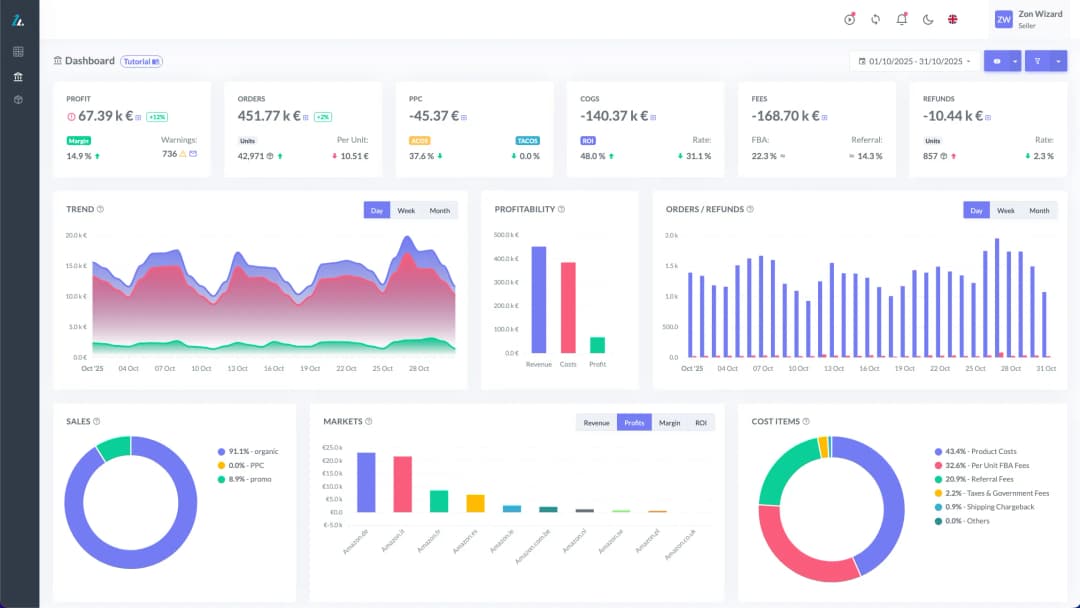
Are you really making a profit?
See your true net margin on every order with ZonWizard's profit analytics.
Learn MoreThe effects on European sellers
Another element, less visible but relevant, is also worth noting. Strong differences in effectiveness remain between the various member states when it comes to identifying non-compliant products. The gap has, however, narrowed compared with the previous year.
For European sellers, and in particular for those selling through marketplaces such as Amazon, we believe this scenario has a double reading. On the one hand, the competitive pressure from low-cost and often non-compliant non-EU products remains very high. On the other hand, the growing attention of European authorities to the compliance of imported products could, over time, partly rebalance the playing field in favour of those selling products that genuinely meet EU standards. A selling point well worth highlighting explicitly in your product listings!
Read also our article FBA or FBM, how to calculate the optimal stock quantity
Customer service is what really tips the balance of satisfaction
The third snapshot comes from an analysis published a few days ago by eShoppingAdvisor, an independent Italian platform specialising in verified reviews, carried out on a sample covering 178 product categories and almost 3,000 recurring themes extracted from consumer reviews. The most useful result concerns precisely customer service, which turns out to be the most polarising element of the entire online shopping experience. It is at the same time the third most cited theme in positive reviews, with around 3,700 mentions. And it is also the number one reason for complaint overall, with around 1,190 negative references linked to expressions such as absent support or lack of replies.
No other factor analysed sits at the top of both rankings with such marked polarisation. Well-run customer service can turn a customer into a brand advocate, while its absence becomes the number one cause of abandonment.
Shipping confirms itself in second place for overall impact, with more than 5,300 positive mentions linked to delivery speed but also more than 1,450 negative reports for delays. Product quality remains the most stable and least controversial factor, with more than 7,000 positive mentions against just 380 complaints about poor quality. Among the most critical sectors, the analysis points to transport, car parts and online games, where dissatisfaction often stems not from the product itself but from the handling of after-sales.
Among the practical indications emerging from the study:
- make support genuinely accessible, clearly stating channels and response times;
- treat shipping as an integral part of the offer and not as an external service;
- look after packaging, which affects the perception of quality at a relatively contained cost;
- simplify return and refund procedures;
- guarantee transparency on prices and product features, especially in categories that require more evaluation from the customer.
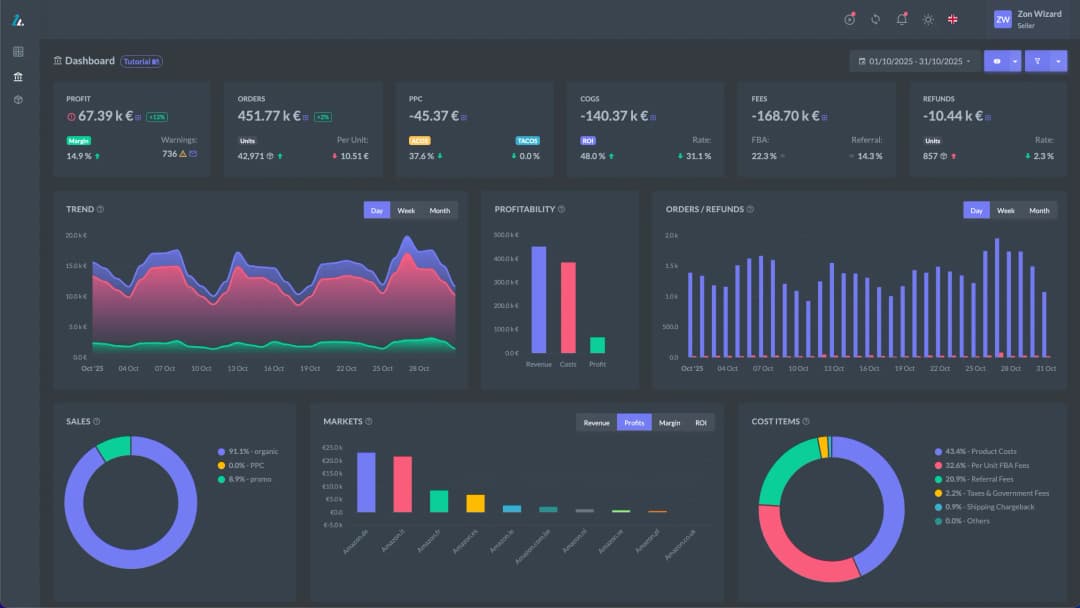
Know your real Amazon profit
Track margins, fees and net profit in one clear dashboard with ZonWizard.
Learn MoreLoading…

Amazon translates product images with AI: what changes for international sellers
Amazon has recently rolled out a feature many international sellers had been waiting for: automatic translation of the text inside product images. Thanks to artificial intelligence, the text overlaid on images (from size charts to technical specs, from feature callouts to comparison infographics) is now translated automatically into the customer’s language, without the seller having…
September 1st, 2026

Why Amazon sometimes deletes listings: what causes it and how to act
If you sell on Amazon, you may already have been through this unpleasant surprise. You open your inventory management page, and one of your listings is gone. No warning, no email, just the feeling of having lost sales, organic ranking and months of work in a matter of minutes. There is good news, though. In…
September 1st, 2026
Ready to transform your business?
Start your free 30-day trial today, setup takes just a few minutes. No credit card required, cancel anytime.