

How repricing affects Amazon margins
Faced with a competitor who has just overtaken you for the Buy Box, the instinct is to lower your prices, even by a few cents, to become the most economically attractive option in the eyes of consumers. It may seem like a sustainable move, but it is often the start of a progressive and very harmful loss.
Subscribe to Newsletter
Articles, mini-guides and updates on Amazon world from leading insiders.
In this guide we look at why, and how to avoid it.
A reminder that the ZonWizard Repricer is coming soon. Subscribe to the newsletter to stay up to date on the Repricer launch.
Read also our article Amazon Auto Buy: the new button that is changing the rules of pricing for sellers
Does the lowest price always win the Buy Box?
First of all, let’s stress that the lowest price does not always win the Buy Box. Amazon assigns the Featured Offer by evaluating several signals together, such as price, shipping method and delivery speed, account health metrics, customer ratings and stock reliability.
In practice, a seller with excellent metrics and Prime shipping can often win even at a price slightly higher than that of a less solid competitor. Price therefore matters most when the other factors are equal.
The consequence is far from marginal. If your account is healthy, you have more room for manoeuvre on price. In short, going below every competitor often means giving up margin you didn’t need to give up to win the Featured Offer.
When you lower the price, in fact, your costs do not go down: the purchase of goods, logistics and shipping stay the same. True, the referral fee drops a little, because it is a percentage of the sale value, but it is still only a small fraction of the price cut. Almost all of the discount therefore comes out of your profit, which per unit is a small slice of the price.
A scenario like this creates a leverage effect against you, and so to match your total profit after a price cut, you need to sell more units, which you can calculate with this formula:
Volume increase needed = price cut ÷ (margin − price cut)
(price cut and margin expressed as a percentage of the price)
Example: how much more you need to sell
Let’s take as an example a product with a net margin of 25% on the selling price. Below are the additional volumes needed to earn the same total:
| Price cut | Profit lost per unit | Extra units to break even |
|---|---|---|
| 2% | 8% of profit | +9% |
| 5% | 20% of profit | +25% |
| 10% | 40% of profit | +67% |
| 15% | 60% of profit | +150% |
The closer the price cut gets to your margin, the more the volume required increases. A 10% price cut on a product with a 25% margin therefore requires almost two thirds more sales, and few price cuts on Amazon generate a similar growth in demand!
Let’s take an even more detailed example, with a product sold at €40.00, with a net margin of 25% (€10.00 profit per unit) and 80 units a week.
- Current situation: 80 × €10.00 = €800 weekly profit
- After a 5% price cut (€38.00): profit drops to €8.00 per unit
- To get back to €800 you need 800 ÷ 8 = 100 units, i.e. +25% volume
- If sales only rise to 90 units: 90 × €8.00 = €720
You sold 12.5% more and earned €80 less a week, about €4,000 a year on a single product. On the sales dashboard it looks like a good result but… the income statement says otherwise!
Are you really making a profit?
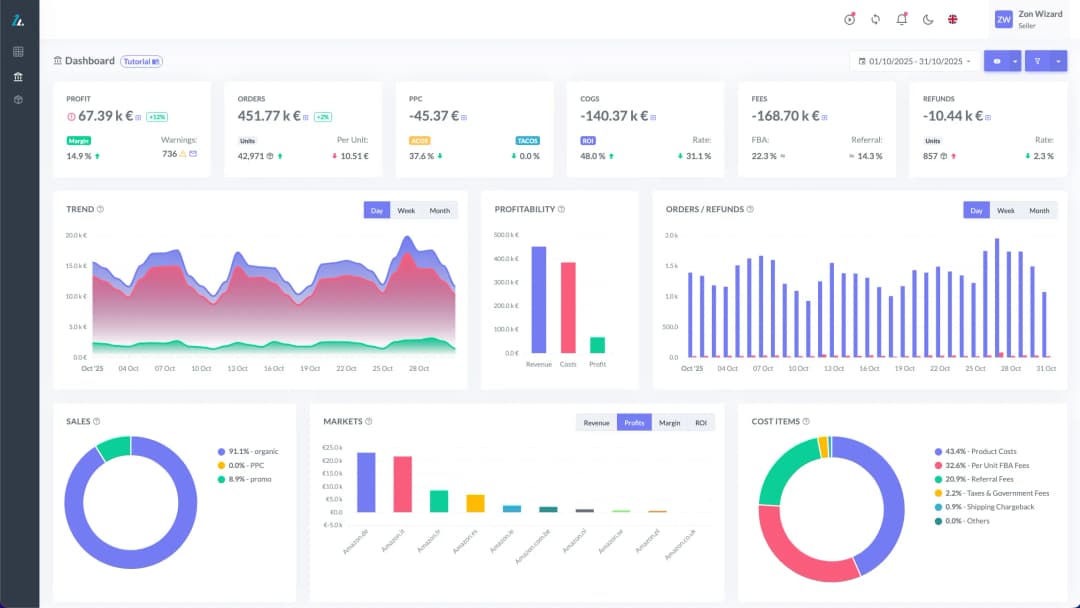
See your true net margin on every order with ZonWizard's profit analytics.
Learn MoreThe problem of repricers chasing each other
There is a second problem that needs to be managed. If your rule is to undercut competitors’ prices, and the competitor uses a similar rule, the two software tools chase each other: you go down, they go down, you go down again. Nobody gains a stable share of the Buy Box and both lose margin with every round.
Here too, an example can make clearer what we are talking about. On a €40 product with €10 profit, 50 price cuts of one cent each bring the price down by €0.50. It seems little, but it is actually 5% of your profit per unit. And the price does not go back up on its own when the chase ends!
In short, a purely reactive rule is predictable, but it gets dragged along by anyone, including sellers who are liquidating stock and have nothing to lose.
Read also our article New Amazon Price Policy: what changes for sellers and how to adapt
How to reprice without destroying your margin
At this point we can try to outline a repricing approach on Amazon that does not destroy your margin:
- Set a minimum price based on real cost. Below that threshold no sale is worth it, whatever the market does.
- Also set a maximum price. When competitors run out of stock or demand grows, you want the price to rise on its own.
- Choose who to compete with. A seller who ships themselves is not always a real threat to those who use Amazon’s logistics. Comparing yourself with comparable offers avoids unnecessary price cuts.
- Measure margin, not just the Buy Box. If your Buy Box share goes up and profit per unit goes down, you need to understand whether the trade-off is worth it.
- Review your rules when costs change. An increase in purchase cost or fees shifts the point below which it is not worth selling.
Read also our article Understanding all the Amazon fees
Mistakes to avoid
In light of all this, there are some mistakes you should avoid, and they are very common even among the most experienced sellers:
- Thinking that the lowest price guarantees the Buy Box.
- Evaluating a pricing strategy only on revenue: revenue can rise while profit falls.
- Leaving the same minimum price for months, even though costs and fees change.
- Applying the same logic to the whole catalogue.
Read also our article What is ROI and how is it calculated
Frequently asked questions
Competing on price is not wrong. Doing it without knowing how much it costs is! In this sense the repricer can be a great help, but remember that the best repricer is certainly not the one that goes down fastest, but the one that wins the Buy Box when it pays and stops when it no longer does. We therefore conclude our in-depth article with a series of answers to the most frequently asked questions on the topic.
How much do I need to lower the price to win the Buy Box? It depends on your seller profile. Often less than you think, because price is only one of the factors evaluated.
Is a small price cut really a problem? A single minimal price cut, no. The problem arises when it is repeated automatically dozens of times and competitors do the same.
How do I calculate whether a price cut is worth it? With the formula above: divide the price cut by the difference between margin and price cut, and compare the result with the increase in sales you can realistically expect.
Do I need a repricer or can I do it by hand? On competitive listings prices change too often to follow them by hand. But automation only helps if it respects real margin limits.
The ZonWizard repricer will work within the margin limits you set, for the sustainability of your business. The price stays within the boundaries that protect your profit. Subscribe to the newsletter to stay up to date on the Repricer launch.
Know your real Amazon profit
Track margins, fees and net profit in one clear dashboard with ZonWizard.
Learn MoreLoading…

Repricer minimum price: how to calculate it without losing money on every sale
When setting up a repricer, all the attention goes to the strategy: chase, stay close, go up. The minimum price is often set in a hurry, with a round figure that looks safe, and then forgotten. Yet it is the number that determines the worst sale the software is allowed to make, and the repricer…
November 3rd, 2026

What an Amazon repricer is and what it is for
If you have been selling on Amazon for a while, you have probably also come across a rather unfavourable scenario. You open Seller Central, check a product and find that a competitor has adjusted their price, that the Buy Box has gone to them and that your sales have slowed down. In short, you have…
November 3rd, 2026
Ready to transform your business?
Start your free 30-day trial today, setup takes just a few minutes. No credit card required, cancel anytime.