

New Amazon Price Policy: what changes for sellers and how to adapt
Amazon has updated its rules on reference prices, and sellers who have so far exploited inflated discounts to increase conversions must prepare for a major change. The new price policy for listings came into effect on April 23, 2026, and it changes the game regarding the display of strikethrough prices and discounts on the marketplace.
Subscribe to Newsletter
Articles, mini-guides and updates on Amazon world from leading insiders.
In a context where 60% of online buyers indicate price as the main purchasing factor, it is clear that this modification is certainly not a detail. Conversely, it is a strategic matter. An issue that can directly affect conversions, visibility, and the profitability of your account. Let’s see what changes, why Amazon decided to intervene, and how you can adapt your strategy.
>>> Also read our article Amazon Quarterlies, Prime Day and more: the 2026 calendar for sellers and vendors <<<
What the new Amazon price policy provides
Until today, many sellers used inflated list prices to create the impression of a high discount. If a product cost 20 euros but was shown with a strikethrough “recommended price” of 40 euros, the customer perceived a 50% saving even if that higher price had never actually been applied. Well, Amazon has decided to put an end to this practice with much stricter evidence requirements.
Starting from April 23, 2026, in fact, every reference price shown on a product detail page must be verifiable. Specifically, the List Price (the strikethrough list price) must be supported by one of the following conditions:
- Actual real sales at that price on the Amazon Featured Offer
- Evidence of price at other retailers, i.e., proof that that price exists (or recently existed) at least at one other verifiable retailer. If neither condition is met, the crossed-out price is not shown.
No strike-through, no indication of savings, no highlighted discount percentage. The product appears with the selling price only, without any comparative reference.
>>> Read also our article Returns on Amazon are increasing: what can we do? <<<
How the calculation of Typical Price changes
Another relevant modification concerns the mechanism of the Typical Price, i.e., the “typical” price that Amazon shows as a reference when the List Price is not available or not validatable.
With the new rules, the Typical Price is calculated taking into account all sales, including promotional ones, if the Featured Offer price has remained below the non-promotional median for more than half of the last 90 days.
In simple words: if you have kept your product on promotion for over 45 days in the last three months, Amazon considers that discounted price as your “normal” price. Consequently, the Typical Price also drops, making it even harder to show a credible discount when you return to full price.
The change is of significant impact for those who manage frequent or prolonged promotions. Keeping a product constantly on discount is no longer a neutral tactic. Instead, it has direct consequences on how Amazon classifies your reference price.
Are you really making a profit?
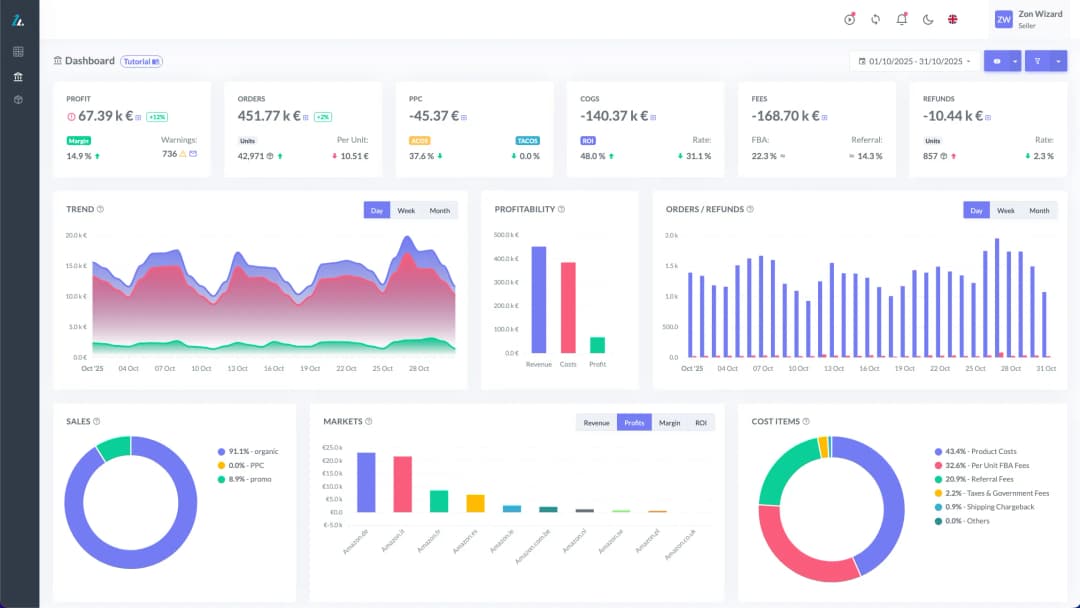
See your true net margin on every order with ZonWizard's profit analytics.
Learn MoreWhich promotions are excluded from the new policy
Amazon has specified that some types of promotions are excluded from the recalculation of the typical price. In particular, sales made through the following are not considered for Typical Price purposes:
- Coupons
- Buy X Get Y offers
- Subscribe & Save
- Prices applied during peak events (e.g., Prime Day, Black Friday).
These are important exceptions. They mean that you can continue to use these promotional tools without them negatively influencing your reference price. If you are building a promotional strategy, focusing on these channels rather than direct and prolonged price reductions is now even more advantageous.
Do you want to keep your product prices under control? Try ZonWizard for free →
Sanctions provided for those who do not comply with the new rules
Amazon does not limit itself to removing the struck-through price in case of violation. The consequences can indeed be more serious. The Fair Pricing Policy, which the new policy strengthens, provides for a progressive enforcement system based on the severity and repetitiveness of the infraction.
Here are the main actions Amazon can take:
- Removal from the Featured Offer for non-verifiable or misleading reference prices
- Suspension of selling privileges for prices significantly higher than recent offers, both on Amazon and other channels
- Corrective actions or removal for those who apply a higher cost per unit in multi-packs compared to the single product
- Account suspension in case of excessive shipping costs or repeated violations.
Consider that Amazon actively monitors price history to identify suspicious patterns. And the checks are not occasional. The algorithm continuously analyzes your price data and compares them with those of other retailers and your own sales history. A single violation can be corrected, but systematic behavior risks leading to much more serious consequences.
>> Read also our article FBA or FBM, how to calculate the optimal stock quantity <<<
Why Amazon has decided to intervene now
In recent years, the proliferation of fake or inflated discounts has eroded consumer trust in the prices shown on the marketplace. Several studies and journalistic investigations have highlighted how many products on Amazon showed struck-through prices that did not correspond to real prices ever applied, creating an illusion of savings.
Amazon, on the other hand, has every interest in maintaining buyer trust. A customer who feels cheated does not return. In this sense, the new policy is consistent with the company’s long-term philosophy, also confirmed in Andy Jassy’s 2025 shareholder letter, which reiterates how customer obsession is the foundation of every strategic decision.
There is also a competitive component. With the growth of alternative marketplaces, Amazon must prove it offers credible and transparent prices. A platform where discounts are reliable is a platform where customers buy with more trust, and more frequently!
>>> Read also our article What is ROI and how is it calculated? <<<
Practical impact on conversions and pricing strategy
The most immediate change many sellers will experience is the disappearance of the struck-through price from their product detail page. For those who had based part of their conversion strategy on this visual lever, the impact can be significant. The struck-through price and the discount percentage are elements that capture attention and create urgency: removing them means losing an important persuasion tool.
However, those who build their strategy on real and verifiable reference prices have nothing to fear. They will be able to continue showing discounts, provided they are supported by concrete data. The difference is that from now on you have to earn the right to show a discount, not simply declare it.
On the operational level, sellers must intervene on several fronts:
- Review of active list prices. Verify which List Prices are actually supported by real sales or other retailers’ prices
- Price history analysis. Understand how many days in the last 90 the product has been sold on promotion and how this affects the Typical Price
- Recalibration of promotions. Prioritize coupons, Subscribe & Save, and structured offers over direct and continuous price reductions
- Cost review. With less leverage on perceived discounts, competitiveness must come from lower real prices, which requires careful analysis of product, logistics, and advertising costs
ZonWizard helps you analyze margins, costs, and PPC in one place. Start your free trial →
How to adapt the advertising strategy
The new policy also has repercussions on advertising. Many sellers structured Sponsored Products campaigns by focusing on products with obvious discounts, knowing that the struck-through price increased the click-through rate and conversion rate. With fewer products showing strike-throughs, the effectiveness of some campaigns could drop.
Those who manage advertising on Amazon must therefore review their basic assumptions. Bids and budgets must be reconsidered in light of a potential drop in conversion rate on some ASINs, at least in the short term. At the same time, those who had ads with artificially inflated prices and now normalize them could paradoxically improve their competitive position in the long run by selling at more credible prices and building a more solid reputation.
>>> Read also our article Why should an Amazon Seller invest in Google Ads? <<<
Our opinion
The new Amazon policy on reference prices is one of those moves that, in the short term, could create some discomfort. In the long term, however, it should strengthen the system of trust and authority of the marketplace. For serious sellers, who have always worked with transparent prices and sustainable strategies, the change is an opportunity. The playing field will tend to level out and those who have never operated dishonestly will be rewarded.
For those who have built part of their strategy on inflated price lists, the moment to adapt is now, before enforcement becomes even more stringent.
In any case, the message is always to have clear data. Specifically, knowing exactly:
- At what price you sold in the last 90 days
- How much you spent on promotions
- What margin you have left
- Where you can recover efficiency.
Without a precise vision of these data, any pricing decision becomes an operation in the dark. ZonWizard was born to give you exactly this visibility, so you can make informed decisions in a marketplace that constantly changes the rules. Try our services for free!
Know your real Amazon profit
Track margins, fees and net profit in one clear dashboard with ZonWizard.
Learn MoreLoading…

EU tax on small parcels from 1 July 2026: what changes for Amazon sellers
On 1 July 2026 a new European tax of 3 euro on every small parcel arriving from non-EU countries came into force, applied to products worth up to 150 euro. This abolishes a customs exemption that had existed since 1992 and that, until now, had allowed low-value shipments to enter the EU duty-free. Of course,…
July 9th, 2026

75-character Amazon titles: how to prepare for the 27 July 2026 change
From late July 2026, Amazon will reduce the space available for product titles. In other words, the limit drops from 200 to 75 characters, spaces included. Sellers who don’t adapt in time risk having their title rewritten directly by the platform’s artificial intelligence, with no say in the matter. Better, then, to act ahead of…
July 9th, 2026
Ready to transform your business?
Start your free 30-day trial today, setup takes just a few minutes. No credit card required, cancel anytime.