

Google SEO and Amazon SEO: what are the differences?
Two platforms, two completely different logics. And understanding how each one works is the first step to selling more and building a solid brand online. We are talking, of course, about Google and Amazon.
If you sell products online, you have certainly heard of SEO. But there is one mistake many sellers make: thinking the rules of the game are the same everywhere. In reality, optimising a web page for Google and optimising a listing on Amazon are two profoundly different activities, with distinct objectives, metrics and algorithmic logics.
Subscribe to Newsletter
Articles, mini-guides and updates on Amazon world from leading insiders.
And yet you often see people investing in SEO for their own website and expecting the same results on Amazon. Or, the other way round, people who look after their listings while completely neglecting their presence on traditional search engines. Both approaches leave some rather interesting opportunities on the table.
That is exactly why, in this article, we look in detail at the differences between Google SEO and Amazon SEO. Together we will see:
- how the two algorithms work
- which ranking factors matter most
- how to build a strategy that uses both platforms in an integrated way.
Let’s get started!
Two platforms, two completely different objectives
The starting point is understanding why these two platforms exist and what they are trying to achieve.
First of all, Google is an informational search engine. Its goal is to give the user the most relevant and reliable answer to any question. Whether it is a recipe, a news story, a buying guide or a technical deep dive, Google wants to be the most useful source at that moment.
Amazon, on the other hand, is a commercial search engine. Every search on the platform is made by someone whose intent to buy has already formed. The algorithm does not ask itself what the best answer to a question is. Rather, which product is most likely to generate a satisfying sale.
It is anything but a marginal difference in objective, and it is reflected in everything: the ranking factors, the type of content that works, the metrics to optimise and even the way keyword research is done.
In short: Google answers questions. Amazon sells products. Keeping that in mind is the foundation of any effective digital strategy!
Read also our guide Amazon inventory management: a guide to optimising your stock
How SEO works on Google
Now that things are a little clearer, let’s take a step forward. When a user runs a search, Google does not consult the web in real time. Instead it draws on its own index, built in advance through a continuous process of crawling and indexing. Its bots explore billions of pages, analyse their content and decide whether and how to store them. Only later, when the query comes in, does the algorithm assess which indexed pages are most relevant and rank them accordingly.
What makes SEO on Google complex is the number of signals the algorithm takes into account. The quality and originality of the content, for instance, come first. Google rewards those who write for human beings, not those who optimise mechanically for search engines. Then there is domain authority and the site’s technical experience: loading speed, mobile optimisation, URL structure, schema markup. Finally, behavioural signals count too, such as time on page and bounce rate. In other words, if users land and immediately go back, Google reads that content as not very useful.
An element that is often underestimated is search intent. Catching the right keywords is not enough, because the format and tone of the content must match what the user expects to find. A commercial keyword like “best wireless earbuds” calls for a comparison article, not a product page. A transactional keyword like “buy Sony wireless headphones” calls for a direct sales page instead. Getting the format wrong, even with perfect keywords, means reducing your chances of ranking well.
Are you really making a profit?
See your true net margin on every order with ZonWizard's profit analytics.
Learn MoreHow SEO works on Amazon
Amazon has built its own search algorithm with a very precise goal: to maximise sales and customer satisfaction. Every ranking decision is therefore geared towards showing at the top the products most likely to generate a successfully completed transaction. In that sense, Amazon is perhaps the most transparent search engine there is: its incentives are perfectly aligned with those of the best-performing seller.
The algorithm assesses each listing along two main axes. The first is relevance: does the product match what the user searched for? Do the title, bullet points, description and backend search terms contain the right keywords in the right place? The second axis is performance: does the product generate sales? Does it have positive reviews? Does it convert well against the competition? Is it always in stock?
Remember that, naturally, these two levers are not separate. Relevance brings clicks, clicks bring sales, sales improve ranking, ranking brings more relevance. It is a system that rewards those who are already strong, but it is also open to anyone who optimises methodically.
Unlike Google, on Amazon there are no backlinks, there is no site structure to optimise, and informational content carries no weight at all. What counts is the ability of your listings to convince a shopper to click and buy. Price matters. Image quality matters. The number and quality of reviews matter. And stock availability matters too, because a sold-out product loses positions quickly and struggles to win them back even after it returns.
Read also our article How to sell on Amazon USA: The Complete Guide for European sellers
Keyword research: same name, opposite logics
One of the most common mistakes is applying the same keyword research criteria to both platforms. The basic mechanics are similar (you look for the terms users type to find what you offer) but the underlying logic is radically different.
On Google you work across the whole purchase funnel. The same product category generates very different keywords depending on the stage the user is at. For example, the keyword “how to choose an ergonomic chair” is informational, “best ergonomic chairs for back pain” is commercial, while “buy ergonomic chair online” is transactional. A well-structured site tries to cover all three stages with different content, building the right authority over time. Search volume, keyword difficulty and analysis of editorial competition can shape those choices.
On Amazon, by contrast, you work almost exclusively on the transactional stage. The user already knows what they want, they are just looking for the right product at the right price. The keywords that count are the high purchase-intent ones, often more specific and lower-volume than those used on Google. Analysing competitor ASINs is essential here, to understand which terms the products competing with yours rank for. And backend search terms let you catch synonyms, spelling variants and related terms without weighing down the visible copy.
Remember that the goal is not just volume, but the ability to convert. A keyword with a thousand searches a month that brings no sales is worth less than one with two hundred that converts.
In other words, the keywords that work on Google and the ones that work on Amazon can be very different, even for the same product. Mixing them up means wasting resources and losing visibility on both fronts!
Read also our article Amazon and the fight against counterfeiting: 15 million fake products blocked in 2025
Google SEO vs Amazon SEO: comparison table
At this point, let’s look at a direct comparison of the main parameters that separate the two platforms:
| Factor | Google SEO | Amazon SEO |
| Primary objective | Provide the best information | Generate product sales |
| Search intent | Informational, commercial, transactional | Almost exclusively transactional |
| Type of content | Blog, guides, landing pages, video | Product pages (listings) |
| Backlinks | Essential for authority | Not considered |
| Reviews | Indirect engagement signal | Direct ranking factor |
| Conversion rate | Secondary signal | Primary ranking factor |
| Site speed | Direct ranking factor | Not applicable |
| Images | Support the content | Lever on CTR and conversion |
| Time to results | Weeks / months | Days / weeks |
| Success metrics | Organic traffic, engagement | Sales, revenue, Buy Box |
The most common mistakes on both platforms
Understanding the differences between the two platforms also helps you avoid the typical mistakes of those who confuse them or approach them without the right preparation.
On Google in particular, the most frequent problems concern content quality:
- duplicate pages that add no real value
- keyword stuffing that penalises more than it helps
- search intent ignored.
On top of these come technical problems such as slow sites, sites not optimised for mobile, or crawling errors that block indexing.
On Amazon, the most common mistakes are of a different nature: they concern the quality of the listings and day-to-day operations. The most recurrent are:
- generic or too short titles, which do not include the main keywords and communicate nothing distinctive;
- backend search terms left empty or filled with irrelevant terms, wasting valuable space for discoverability;
- low-quality images, which cut the click-through rate and undermine customer trust before they even read a word;
- bullet points that list technical features without turning them into concrete benefits for the buyer;
- negative reviews ignored or unmanaged, which progressively drag down rating and ranking;
- stockouts: even a single out-of-stock period causes losses in position that are hard to recover.
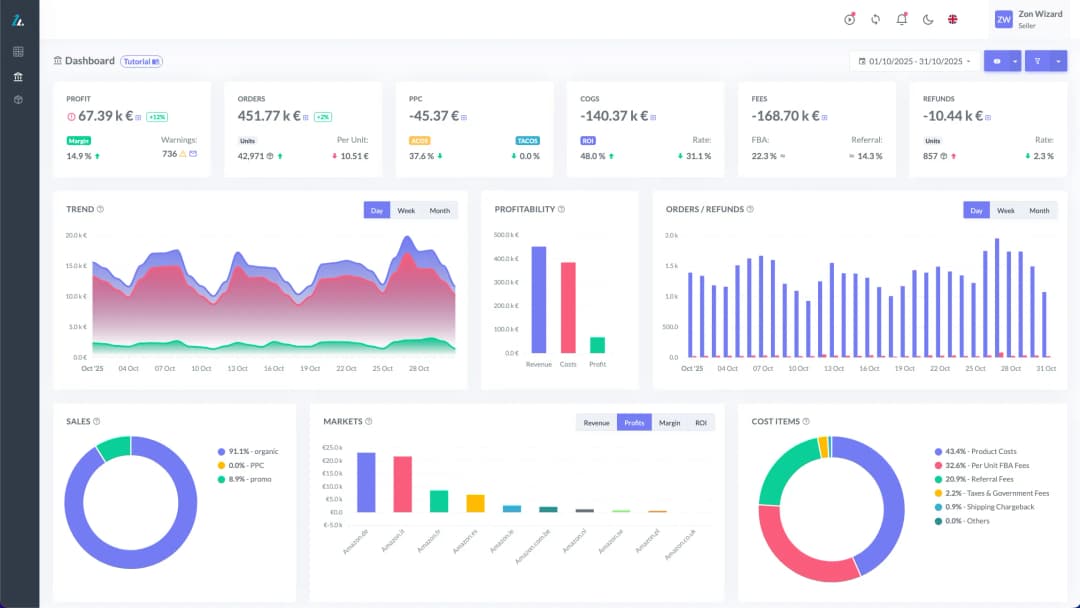
Always keep your real margins on Amazon under control: with the ZonWizard Profit Tool you can track FBA fees, PPC costs and net margin for every ASIN, in real time.
Read also our article Claude Sonnet 4.6 on Amazon Bedrock: what changes for sellers
Google and Amazon are not in competition: how to use them together
With all that said, we believe the real opportunity for an Amazon seller is certainly not choosing between Google SEO and Amazon SEO, but building a strategy that makes them work in synergy. The two platforms cover different stages of the customer’s buying journey, and combining them means having a presence across the whole funnel, from brand discovery to the transaction.
The mechanism is simpler than it seems. Google attracts users at the stage where they are still looking for information, comparing options or forming a preference. A well-ranked blog post, a buying guide or an in-depth article builds trust and brand authority long before the customer is ready to buy. When that trust has matured and the intent to buy has formed, the customer looks for the product on Amazon (and here they find optimised listings), positive reviews, a competitive price. The sale happens with far less friction because the brand is already known.
There is also a direct effect worth knowing about. External traffic to your Amazon listings (generated by blog articles, social content or email campaigns) is recorded by the algorithm as a positive signal, potentially improving the product’s organic visibility on the platform. Amazon rewards those who bring in traffic from outside, because it reduces the platform’s own customer acquisition costs. Investing in Google content, then, is not just a brand strategy: it has a measurable impact on Amazon ranking too.
Read also our article Amazon’s artificial intelligence does not look at the rankings (and for sellers that is very interesting!)
Optimising your Amazon listings
Since the logic of Amazon SEO is less intuitive than Google’s, it is worth dwelling on three elements of a listing that make the clearest, most concrete difference.
The title
It is the first element read by both the algorithm and the customer. It must contain the main keyword, the product’s distinctive features (material, dimensions, colour, quantity where relevant) and the brand. The mistake to avoid is keyword stuffing: a title that is unreadable for a human being hurts the click-through rate even if it is packed with relevant terms. The goal is copy that works for the algorithm and convinces the customer to click.
The images
Images are the main driver of click-through rate and conversion on Amazon. The main image must meet the platform’s standards, while secondary images are the space to communicate: show the product in use, make the real dimensions clear, highlight construction details, use infographics for the more complex information.
It is worth recalling that Amazon has recently introduced AI-powered automatic translation of the text in images in 14 marketplaces: if you sell in several European countries, it is important to monitor the translations the algorithm generates and to upload your own optimised versions when critical terms (technical specs, dosages, brand names) demand precision.
The bullet points
The five bullet points are the space to convince someone who has already clicked to go ahead and buy. The fundamental principle is turning every technical feature into a concrete benefit for the buyer. Not “5000 mAh battery“, but “up to 48 hours of use without recharging“. Include secondary keywords naturally and address head-on the most common objections a potential buyer might have.
In short: two strategies, one objective
Google SEO and Amazon SEO are not alternatives where you pick one or the other. They are two distinct levers of a complete digital strategy. Google builds awareness, generates qualified traffic and consolidates brand authority over the long term. Amazon catches the intent to buy at its hottest moment and turns it into a sale.
Anyone who uses them together (with content optimised for the informational funnel on one side and listings polished down to the last detail on the other) builds a solid competitive advantage that is hard to replicate.
The prerequisite for doing it well is having clear data on your own performance: knowing which products are profitable, which margins hold up after fees and advertising costs, where you lose sales to stockouts. Without a precise view of those numbers, any optimisation risks being an exercise in the dark.
If you want to structure your presence on Amazon professionally, from real margins to performance per ASIN, from inventory to pricing, ZonWizard is the tool designed to give you all the data you need, in a single platform.
Try ZonWizard free for 30 days — no credit card required!
Know your real Amazon profit
Track margins, fees and net profit in one clear dashboard with ZonWizard.
Learn MoreLoading…

Selling with PrestaShop: an introductory guide for those starting from scratch
When people decide to open an online store, the names that come up most often are usually Amazon and Shopify. But there is another route, one geared towards full control of your own store: PrestaShop. PrestaShop is in fact one of the most widely used e-commerce platforms in Europe, chosen by hundreds of thousands of…
October 6th, 2026

Selling on multiple channels profitably: the practical guide to getting started!
Selling only on Amazon is a great starting point, but today most sellers who really want to grow are looking at multichannel selling: eBay, Shopify, WooCommerce, PrestaShop, and perhaps several Amazon marketplaces at once. The potential is huge. More channels mean more customers reached, less dependence on a single algorithm and steadier revenue.
October 6th, 2026
Ready to transform your business?
Start your free 30-day trial today, setup takes just a few minutes. No credit card required, cancel anytime.