

Amazon quarterly results: what changes for marketplace sellers after Q2 2026
Amazon has published its second-quarter results, closing the period with record numbers. The quarter brings in 200.6 billion dollars of net revenue, up 20% on the same quarter in 2025, and an operating profit of 27.5 billion dollars (+43% year on year). Impressive figures, but if you sell on Amazon the main question you are asking yourself is probably not how much Amazon earned. Rather, you are probably wondering what changes for your business in the coming months.
In this article we have deliberately set aside the technicalities of the financial statements. Instead we have focused on all the news announced alongside the results that can have a concrete impact on a seller’s daily life: advertising, logistics, AI, new sales channels and operational tools.
Subscribe to Newsletter
Articles, mini-guides and updates on Amazon world from leading insiders.
Advertising grows 26% and Ads Agent becomes ever more central
Advertising continues to be one of the strongest engines for Amazon, up 26% year on year. But the most interesting figure for anyone running campaigns is not the growth itself. It is rather the spread of Ads Agent, the artificial-intelligence tool that automates planning, launching and managing advertising campaigns. During the quarter it was extended to 11 new countries and, according to the data released by Amazon, sellers who use it record a cost per impression 8% lower and a cost per acquisition 6% lower than those who do not.
The signal is fairly clear. Amazon is pushing more and more towards automated (and, from the point of view of manual control, increasingly opaque) management of ad campaigns. For sellers the message implies at least two things. The first is that, on one side, it is possible to gain efficiency by relying on these tools. The second is that, on the other side, it becomes essential to monitor results carefully to understand whether the automation is really working in your favour or is simply spending budget more aggressively.
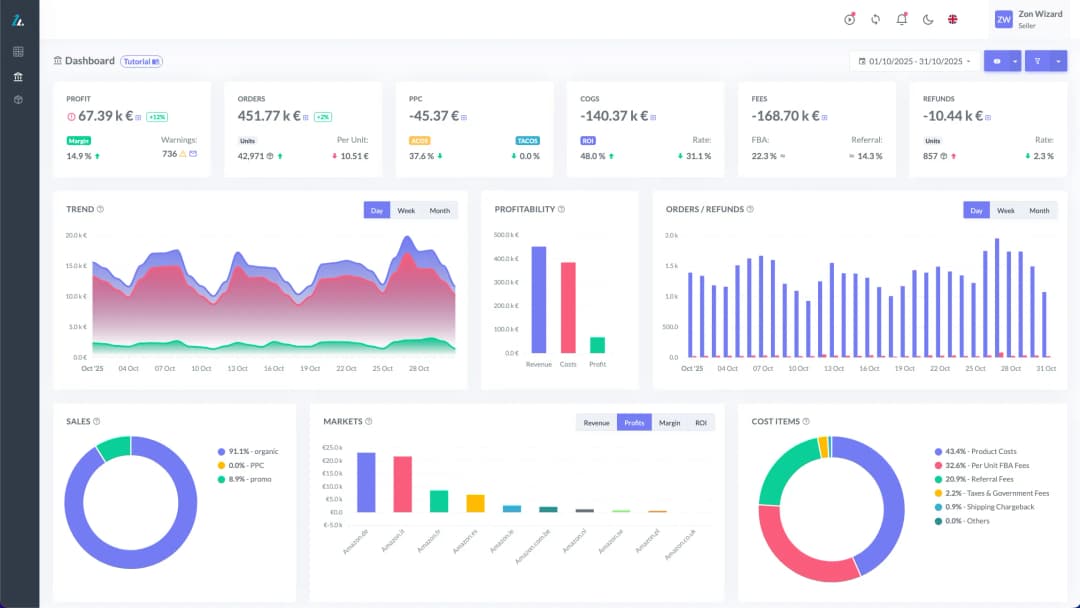
If you run your own PPC campaigns and want to understand whether you are really optimising your ad spend (or whether Amazon’s automation is simply making you spend more), take a look at our features and find out where to step in.
Read also our article How to sell on Amazon USA: The Complete Guide for European sellers
Alexa for shopping is starting to weigh on sales
Amazon has merged Rufus and Alexa+ into a single assistant, Alexa for Shopping. The numbers released by the company point to active users almost doubling in the quarter and interactions growing more than fivefold year on year. But the figure that should give every seller pause is another one. Customers who use Alexa for shopping spend on average more than 40% more per order than those who do not.
The statistic shared by Amazon tells us that buying habits are changing. More and more customers reach the product through conversational search and personalised recommendations. And no longer through classic text search alone.
For sellers, then, it is one more reason to look after titles, bullet points and A+ content so they are understandable to an AI assistant that has to “get” the product in order to recommend it, as well as to a human customer scrolling through search results.
Read also our article Claude Sonnet 4.6 on Amazon Bedrock: what changes for sellers
Amazon Now and ultra-fast logistics are a competitive advantage
The 30-minute delivery service, Amazon Now, has added 80 new cities in the United States as well as several cities in Egypt, and is today active in nine countries and more than 250 cities. The growth speaks for itself. It records +80% in gross sales and units sold quarter on quarter, and +60% in customers served. The classic Prime service also set delivery-speed records, with more than 40% more items delivered same day or next day in the first half of the year.
For sellers, it is clear that this trend reinforces a point we often repeat in our regular analyses. Delivery speed is by now a competitive factor just as much as price and reviews. Products handled through FBA or included in fast-delivery programmes tend to benefit from better visibility and conversions. Anyone managing logistics independently risks being cut off from a growing slice of demand.
Are you really making a profit?
See your true net margin on every order with ZonWizard's profit analytics.
Learn MoreAmazon Business and Amazon Supply Chain Services open new B2B opportunities
Amazon Business has reached an annualised growth rate of 60 billion dollars in gross sales, with almost 30% more items available than the previous year and the expansion of same-day delivery of fresh groceries for businesses in more than 2,300 American cities. In parallel, Amazon Supply Chain Services has been launched, a service that allows any company to use Amazon’s logistics infrastructure to manage raw materials and finished products (early customers include names such as Procter & Gamble and American Eagle Outfitters).
Anyone who also sells to business customers, or is considering opening a B2B channel, should watch this growth closely. It means more structured demand, but also higher service standards to meet.
An expanding product selection and new brands
Amazon has added millions of new products to the catalogue. A wider selection naturally means more competition in crowded categories, but also more opportunities in niches that are still lightly covered. In short, here too it is the right moment to review your catalogue positioning and check whether there are white spaces to occupy before others do.
Want to understand which categories are growing fastest and where it makes sense to position your next products? Our service helps you spot the real opportunities, with up-to-date data and not just intuition.
Read also our article FBA or FBM, how to calculate the optimal stock quantity
Bedrock and AI tools for operators
On the AWS front, Amazon has added more than 10 new foundation models to Bedrock, among them OpenAI’s GPT-5.6 and Anthropic’s Claude Opus 5. It has also expanded the capabilities of Bedrock AgentCore with features such as autonomous payments for agents and integrated web search. Amazon has likewise presented AWS Continuum, a tool that uses AI agents to identify and fix vulnerabilities in code.
The announcements mainly concern the enterprise and developer world. They are not, however, irrelevant to those who sell on Amazon. A large share of the third-party tools sellers use every day for
- inventory management
- repricing
- keyword analysis
- customer service
rely precisely on infrastructure like this. It is therefore reasonable to expect increasingly “agentic” features to arrive in seller tools too over the coming months. That is, automations that do not limit themselves to suggesting an action, but carry it out directly.
Read also our guide Amazon inventory management: a guide to warehouse optimisation
What to take away from this quarter
To sum up the key points for those selling on Amazon:
- Increasingly automated advertising: Ads Agent is expanding, but needs careful monitoring.
- Conversational shopping is growing: Alexa for Shopping already affects the average order value.
- Delivery speed remains a decisive competitive advantage, and Amazon Now keeps expanding.
- The B2B channel is getting stronger, with new opportunities for those selling to businesses as well.
- The catalogue is widening, opening up both the risk of greater competition and new niches to cover.
Amazon continues to invest heavily in artificial intelligence and automation, and this quarter confirms it clearly. For sellers, the effort will not be so much about “adopting AI”. It will be more about staying up to date fast enough to take advantage of it before the competition does, without losing control over your own numbers.
Know your real Amazon profit
Track margins, fees and net profit in one clear dashboard with ZonWizard.
Learn MoreLoading…

Amazon translates product images with AI: what changes for international sellers
Amazon has recently rolled out a feature many international sellers had been waiting for: automatic translation of the text inside product images. Thanks to artificial intelligence, the text overlaid on images (from size charts to technical specs, from feature callouts to comparison infographics) is now translated automatically into the customer’s language, without the seller having…
September 1st, 2026

Why Amazon sometimes deletes listings: what causes it and how to act
If you sell on Amazon, you may already have been through this unpleasant surprise. You open your inventory management page, and one of your listings is gone. No warning, no email, just the feeling of having lost sales, organic ranking and months of work in a matter of minutes. There is good news, though. In…
September 1st, 2026
Ready to transform your business?
Start your free 30-day trial today, setup takes just a few minutes. No credit card required, cancel anytime.