

Amazon Price-Fixing Lawsuit: What’s at Stake for the Marketplace (and What Sellers Need to Know)
For years, many Amazon sellers have argued that selling on other platforms at lower prices than on Amazon brings fairly serious consequences. Among them: visibility penalties, a reduced share of the Buy Box, indirect pressure of every kind. Well, today — thanks to a set of documents unsealed as part of an ongoing lawsuit in California — those concerns appear to have found an official documentary basis. The price-fixing lawsuit against Amazon is in fact bringing to light a price-control system that, according to U.S. regulators, may have influenced the entire American e-commerce ecosystem.
Precisely because of how sensitive this topic is and the potential repercussions across the whole Amazon system and on sellers, in this article we look at
- the details of the case
- the implications for sellers
- why it is essential to monitor your pricing strategy on Amazon carefully.
What the price-fixing lawsuit against Amazon is
The legal proceedings began in 2022, when California authorities filed a lawsuit with the Superior Court of San Francisco. According to state regulators, Amazon allegedly put in place business practices capable of distorting competition and influencing prices across multiple online sales platforms, not just on its own marketplace.
California’s Attorney General, Rob Bonta, recently made public an uncensored version of the court documents. The filings describe a system in which Amazon, through its vendors, allegedly pressured brands whenever the prices of their products were lower on competing platforms such as Walmart or Target.
The case is currently in the pre-trial phase, and it will be hard to learn more before 2027. For its part, Amazon has rejected all the accusations, stating that the documents present a distorted reading of its business practices.
How the mechanism worked, according to the documents
But let’s take it step by step. The central point of the whole case is not direct action by Amazon on competitors’ prices. Rather, it is an indirect system that operated through the vendors.
In practice, when Amazon detected that a product was being sold at a lower price on Walmart, Target or other retailers, it did not step in directly by lowering its own price. Instead, it flagged the discrepancy to the vendor of the brand involved. That vendor was then put under pressure to eliminate the price difference. There is plenty of room for interpretation as to what that pressure actually consisted of, but typically the competing retailer was asked to realign its price upwards.
The document cites the case of Arlo as an example. When Walmart offered a discount on some of the brand’s products, Amazon identified the gap and flagged it to the vendor. The price on Walmart was subsequently raised to 649.99 dollars. Similar dynamics are said to have occurred with Levi’s, Hanes and Allergan.
According to regulators, when vendors did not respond to these requests, Amazon allegedly threatened significant consequences. In short, it is said to have leveraged its dominant market position. There is also talk of possible restrictions on product visibility or changes to catalog availability.
An interesting detail highlighted in the documents is that some of these communications deliberately took place outside the official email channels. This, according to regulators, indicates that the company was aware of how potentially problematic the practices in question were.
Why this case matters for Amazon sellers
If you are a seller who sells on Amazon but also on other marketplaces or in your own independent store, this case has direct implications for you. And, to be clear, these are consequences that do not depend on the outcome of a trial that promises to be a long one.
We have tried to sum them up in the lines below.
1. Price parity is a topic that must be addressed with specificity, beyond the contractual clauses
Amazon has always had policies tied to price parity. The marketplace rules require, for example, that products not be offered at lower prices on other channels. But what the lawsuit brings to light is that this control does not happen only through automated tools. Rather, it also happens through a system of flagging and pressure on vendors that involves several levels of the supply chain.
For sellers, this means that monitoring your prices across every sales channel is both good practice and an operational necessity in order to avoid penalties.
2. The Buy Box is even more price-sensitive than you might think
One of the most powerful tools in Amazon’s hands is managing the Buy Box. A price gap compared with other channels can hurt the visibility of your listing, even before any explicit communication arrives. This is precisely why sellers operating on multiple platforms must keep the consistency of their prices under constant control.
3. The vendor system is different from the third-party seller system, but the implications overlap
It is important to clarify that the lawsuit mainly concerns the relationships between Amazon and its vendors (that is, the brands that sell directly to Amazon, which then resells their products). It therefore does not concern third-party sellers who use Seller Central.
However, the pricing dynamics that emerge from the case also involve the broader marketplace system as a whole. They therefore create a context in which understanding how Amazon manages prices becomes a central issue for anyone selling on this platform.
The bigger picture: Amazon under the regulators’ lens
Finally, consider that this lawsuit is certainly not an isolated case. It is, instead, part of a broader antitrust investigation that American and European authorities are conducting into the major digital platforms.
In recent years, Amazon has, for example, had to respond to challenges related to:
-
Self-preferencing practices (favoring its own products in search results)
-
Use of third-party seller data to develop competing products under its own private label
-
The structure of the fees and logistics costs imposed on sellers
-
Policies governing the internal search algorithm.
In this sense, the California lawsuit adds the issue of price control across multiple platforms. Which, make no mistake, is potentially one of the most significant. It concerns the entire online retail world, and not just Amazon.
How to protect yourself: practical tips for sellers
In light of what has emerged, there are a few actions every seller should consider in order to manage their pricing strategy as effectively as possible:
Monitor prices across all channels in real time. Having immediate visibility into what you are selling on Amazon, on your own website, on eBay or on other marketplaces is the first step to avoiding unintentional discrepancies.
Get a clear grasp of Amazon’s price-parity policies. Read the terms of your contract with Amazon carefully. The rules on price parity vary depending on the type of agreement (vendor vs seller) and on the markets.
Document your pricing decisions. In a context where policies can change and legal proceedings can redefine the rules of the game, keeping a record of your pricing decisions can prove very useful!
Keep an eye on how the case develops. The trial will move toward its hearing in 2027. The next phases could bring further details to light and potentially influence Amazon’s policies.
ZonWizard helps you keep everything under control
This is naturally a good occasion to recall that managing an effective pricing strategy on Amazon has never been simple. And that cases like this one show just how complex and constantly evolving the landscape is.
And so, monitoring prices, analyzing the performance of your listings, optimizing your advertising campaigns and keeping profitability under control are all activities that require professional tools.
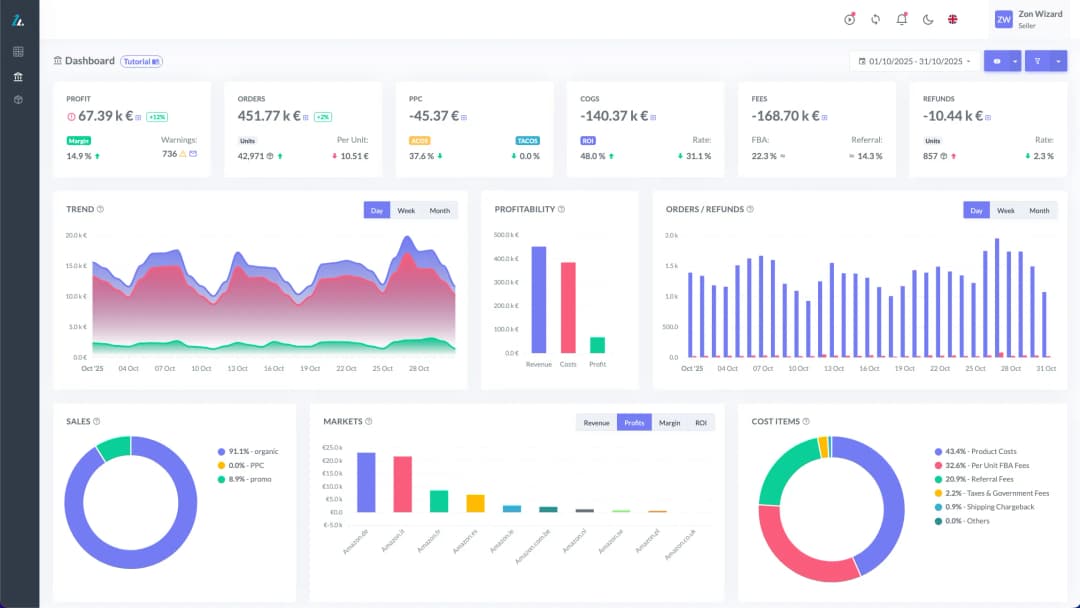
ZonWizard is the platform built for Amazon sellers who want to run their business with precise, up-to-date data. With ZonWizard you can
- monitor the performance of your products
- analyze your real margins, taking every Amazon cost into account
- make pricing decisions based on concrete data rather than mere intuition.
👉 Try ZonWizard for free HERE and discover how to optimize your presence on Amazon in a professional way!
Loading…

EPR in Italy: what Amazon sellers need to know about new environmental responsibilities
The market is experiencing a phase of very important regulatory evolution that concerns those who sell certain product categories both through Amazon and other channels. The changes to the rules on extended producer responsibility, in fact, are a structural change in the way companies must manage the life cycle of their products, with particular attention…
November 26th, 2025

Amazon Intellectual Property Accelerator: Advantages for Seller
Amazon has recently launched its Intellectual Property Accelerator in Italy, France, Germany, Spain, Netherlands and the United Kingdom, as well as it already has in most of the other principal European markets in which it has been long operating. It is an interesting program through which Jeff Bezos’ company stands alongside small and medium-sized businesses with…
January 10th, 2021
Ready to transform your business?
Start your free 30-day trial today, setup takes just a few minutes. No credit card required, cancel anytime.