

Amazon FBM: 5 new requirements arriving between July and October 2026
Amazon has recently rolled out a series of policy updates for Fulfilment by Merchant (FBM) that will take effect between July and October 2026. These are changes worth noting, since they affect delivery metrics, customs handling for shipments from outside the EU and, for those selling in Austria, extended producer responsibility obligations as well.
Subscribe to Newsletter
Articles, mini-guides and updates on Amazon world from leading insiders.
The common thread stated by Amazon is to boost conversion with more reliable delivery promises and to ensure smooth customs clearance. In practice, this means that anyone handling their own shipping will have to meet stricter performance thresholds, or risk having non-compliant offers deactivated. Let’s look point by point at what is changing and from when.
Let’s go through them one by one.
On-Time Delivery Rate (OTDR): minimum threshold 90%
From 15 July 2026 Amazon expects every FBM seller to maintain an On-Time Delivery Rate (OTDR) of 90% or higher. Remember that this metric measures how many FBM units are delivered by the deadline promised to the customer at the time of purchase.
The threshold becomes binding from 1 September 2026. As a result, anyone who stays below 90% risks having non-compliant offers deactivated, or losing the ability to list new products in FBM. You can check the figure in the Account Health dashboard, in the section dedicated to on-time deliveries.
We therefore advise all sellers to check their current OTDR right away through Seller Central. If you are below or close to 90%, you still have a little time before the metric becomes binding. So now is the time to
-
review the handling times you have declared (better to declare realistic times than to risk systematic delays);
-
check the reliability of the carriers you use, especially on the most critical routes or times of year.
Read also our article Amazon and the fight against counterfeiting: 15 million fake products blocked in 2025
Delivery rate during business hours: relevant for those selling to Business customers
From 30 September 2026 a second metric comes into force, distinct from OTDR: the percentage of deliveries made during the working hours of Amazon Business customers. Here too the required threshold is 90%.
From 30 October 2026, anyone who stays below the threshold risks having offers deactivated, but only for sales to Amazon Business customers. If your B2B turnover on Amazon is marginal, the practical impact will be limited. If, on the other hand, a substantial part of your sales comes from business accounts, it is worth monitoring this metric with the same care as the standard OTDR, because the two thresholds are independent and meeting one does not protect you from the other.
Are you really making a profit?
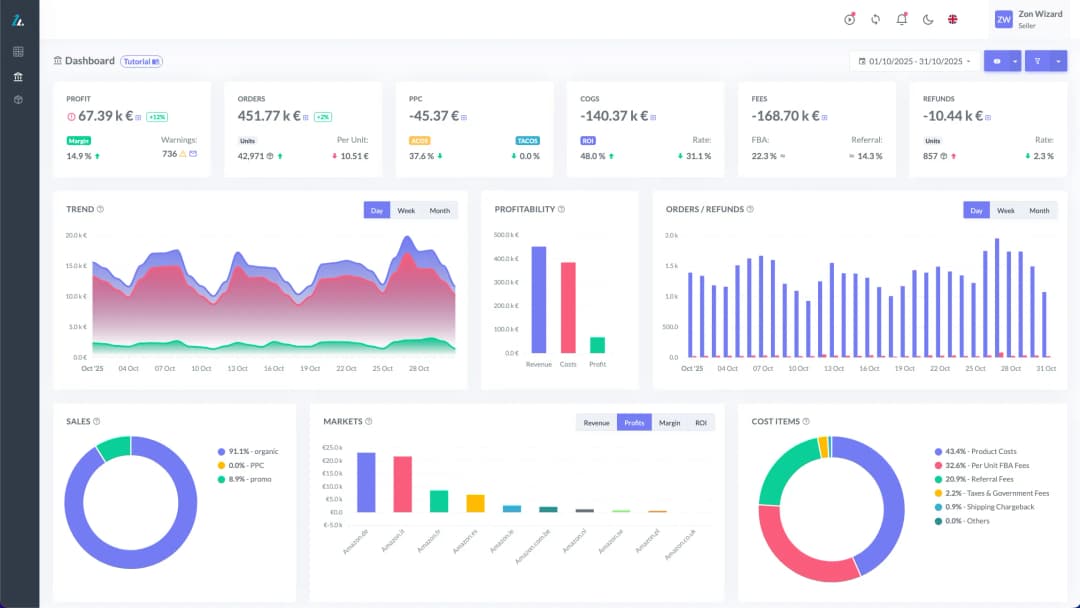
See your true net margin on every order with ZonWizard's profit analytics.
Learn MoreAutomatic handling time if your declared figure is not realistic
From 1 September 2026 Amazon is introducing an automatic corrective measure. If, for an SKU, the handling time you have declared differs by at least one day from your actual performance for more than 30 consecutive days, the system will automatically apply a handling time calculated on your real data, replacing the one you set manually.
In practice, anyone who declares optimistic handling times to look more competitive in search, but then systematically fails to meet them, will have the figure corrected automatically. This is not necessarily a bad thing. An automatic handling time aligned with reality can actually help keep OTDR above the threshold, since the two metrics are linked. It is worth checking the general shipping settings per SKU before the correction kicks in automatically, so you can understand which products show the widest discrepancy and act in time, where possible, on your internal order-management processes.
Read also our article How to sell on Amazon USA: The Complete Guide for European sellers
FBM shipments from outside the EU: end of the customs exemption, IOSS requirement
There is then another operational change affecting anyone shipping via FBM directly from a non-EU country to European customers. From 1 July 2026 the customs exemption for low-value imports is removed. B2C shipments up to a value of €150 are subject to a duty of €3 per item/tariff line on the customs declaration. Amazon makes it clear that this amount is not a fee withheld by the platform, but stems from European Union customs rules.
To keep shipping smoothly in this scenario, Amazon requires three things:
-
Use only a carrier approved by Amazon, authorised to use Amazon’s IOSS (Import One-Stop Shop) number for clearing shipments up to €150. The list of approved carriers is being expanded in the weeks following 1 July, so it should be checked periodically.
-
Provide the carrier with the ASIN details of each product included in the shipment, in addition to Amazon’s IOSS number.
-
Continue to ship in DDP (Delivered Duty Paid) mode, so that the customer does not receive additional payment requests for duties or taxes after purchase. The seller remains responsible for paying duties and customs charges directly to the carrier.
So if you ship via FBM from a non-EU country (typically China or the United Kingdom, depending on the model), urgently check whether your current carrier is among those approved by Amazon for the use of IOSS. If it is not, you risk blocking the customs clearance of your shipments. It is also worth recalculating the margins on products sold with this model, including the €3 duty per item as an additional fixed cost.
Read also our guide Amazon inventory management: a guide to warehouse optimisation
Extended Producer Responsibility (EPR): a new obligation for those selling in Austria
One last point, more limited in scope but not to be ignored by those selling in this market. Extended producer responsibility requirements apply to sales to customers in Austria for three product categories:
-
batteries
-
packaging
-
electrical and electronic equipment (WEEE).
For each category concerned, Amazon requires one of these valid identifiers:
-
an EPR registration number;
-
a GLN (Global Location Number) code for batteries and WEEE;
-
or a VKS (Verpackungskoordinierungsstelle) number for packaging.
Anyone who does not provide the required number for the applicable categories risks restrictions on their offers. Amazon offers an EPR registration option within the Payment in your name service. However, it explicitly clarifies that it does not provide EPR advice or compliance services itself. Registration and any authorised representation are handled by an external provider (ERP Austria GmbH), under its own terms and conditions.
So if you sell batteries, packaging or WEEE to Austria, check as soon as possible whether you are already compliant with EPR registration in that country. If you are not, consider the option offered by Amazon through Payment in your name or a direct registration. Always allow for the technical lead times needed before restrictions on your offers become a real problem.
Read also our article FBA or FBM, how to calculate the optimal stock level
A summary of the deadlines
Alongside these considerations, let’s summarise the main deadlines that need to be given due attention:
|
Date |
What changes |
|
1 July 2026 |
Customs exemption removed on FBM shipments from outside the EU up to €150. Duty of €3 per item, requirement for an approved carrier with IOSS |
|
15 July 2026 |
Expected OTDR threshold ≥ 90% |
|
1 September 2026 |
OTDR below threshold: risk of offers being deactivated or new FBM listings blocked. Automatic activation of the handling time if it has been unrealistic for over 30 days |
|
30 September 2026 |
Expected threshold for deliveries during business hours (Business customers) ≥ 90% |
|
30 October 2026 |
Deliveries during business hours below threshold: risk of offers being deactivated for Amazon Business customers |
Conclusions
The changes we have discussed today are not surprising and go in the same direction Amazon has been taking for some time. That is, more realistic and verifiable delivery promises, and more traceable customs handling for international shipments.
Anyone managing FBM shipping with already solid processes will probably not have to change much. Those who work with tight margins on delivery times, or rely on direct shipments from non-EU countries, have just a few weeks to check carriers, margins and metrics before the thresholds become binding.
Know your real Amazon profit
Track margins, fees and net profit in one clear dashboard with ZonWizard.
Learn MoreLoading…

Selling with PrestaShop: an introductory guide for those starting from scratch
When people decide to open an online store, the names that come up most often are usually Amazon and Shopify. But there is another route, one geared towards full control of your own store: PrestaShop. PrestaShop is in fact one of the most widely used e-commerce platforms in Europe, chosen by hundreds of thousands of…
October 6th, 2026

Selling on multiple channels profitably: the practical guide to getting started!
Selling only on Amazon is a great starting point, but today most sellers who really want to grow are looking at multichannel selling: eBay, Shopify, WooCommerce, PrestaShop, and perhaps several Amazon marketplaces at once. The potential is huge. More channels mean more customers reached, less dependence on a single algorithm and steadier revenue.
October 6th, 2026
Ready to transform your business?
Start your free 30-day trial today, setup takes just a few minutes. No credit card required, cancel anytime.