

Rufus, Amazon’s AI assistant: the features every seller needs to know
Amazon launched Rufus in February 2024 in the United States and has never stopped enhancing it since. What started out as a simple chatbot for answering product questions has transformed into a fully-fledged autonomous shopping agent, capable of
- monitoring prices
- completing orders automatically
- comparing products
- purchasing from stores outside Amazon.
Subscribe to Newsletter
Articles, mini-guides and updates on Amazon world from leading insiders.
With these capabilities, it is clear that for sellers operating on the marketplace, Rufus is a technological companion to reckon with. It is a tool that is concretely changing the way customers find, evaluate and purchase products.
Understanding how it works has become an integral part of an effective sales strategy. Let’s explore together what its most interesting features are today.
What Rufus is and why it is becoming so important in the shopping experience
First of all, as is well known, Rufus is the conversational AI assistant integrated into the Amazon app and also accessible from desktop. Customers activate it via its dedicated icon and can ask it questions in natural language, such as:
- searching for products for a specific activity
- comparing items
- setting price alerts.
The most interesting novelty in the recent updates is the agentic nature of Rufus. The assistant does not merely provide information. It can instead act autonomously on behalf of the user
- adding products to the cart
- completing purchases when a certain price is reached
- scheduling recurring reorders.
We are therefore witnessing a significant qualitative leap that shifts the centre of gravity of the shopping experience from manual search to intelligent delegation.
For sellers, the takeaway is clear. Customers are increasingly interacting with products through an AI intermediation layer — no longer directly through traditional search results. The implications for visibility, conversions and pricing must be thoroughly understood.
Also read our article How to Sell on Amazon USA: The Complete Guide for European Sellers
Rufus’s main features
With that in mind, let us look together at some of the main features of Rufus currently available.
Price history and value transparency
One of the most relevant features for sellers is the ability for customers to view the price history of a product over the past 30, 90 or 365 days. They can simply ask Rufus
- Has this product ever been on sale in the last three months?
- What is the lowest price in the last 90 days?
and receive a detailed chart of its price trend.
The feature significantly increases customer awareness of the real value of an offer. An apparently discounted price that has actually remained unchanged for months becomes immediately readable. For sellers, this means reinforcing a consistent and credible pricing strategy over time. Artificial discounts or frequent and poorly justified price changes risk being perceived negatively by increasingly informed customers.
Also read our article Amazon Quarterly Earnings, Prime Day and More: the 2026 Calendar for Sellers and Vendors
Price alerts and automatic purchase when the target is reached
Rufus allows customers to set price thresholds and delegate to the AI the completion of the purchase when that threshold is reached. The user can say
- Buy me these headphones when they cost less than €80
- Alert me when this cream drops below €30
and Rufus monitors the price. If configured to do so, it purchases automatically using the customer’s default payment method.
From the seller’s perspective, the feature introduces a new dimension in repricing management. If a product is identified by many customers as desirable but only at a certain price, lowering it even temporarily could generate a wave of automatic purchases. At the same time, it means that sellers using dynamic repricing strategies must be aware that some price changes can trigger purchases in an immediate and automated way.
Scheduled Actions: programmed and recurring shopping
Among the most interesting new features is Scheduled Actions, which allows customers to configure Rufus to carry out recurring purchase tasks.
Some examples include monthly reordering of household products, automatically adding children’s snacks to the cart, or being notified when a favourite author publishes a new book.
For sellers of products with recurring consumption (food, supplements, cleaning products, pet supplies), this feature becomes a major opportunity. Customers who set a Scheduled Action for a category effectively become scheduled repeat buyers, making it even more strategic to position oneself well in that category, have solid reviews and competitive and stable pricing.
Are you really making a profit?
See your true net margin on every order with ZonWizard's profit analytics.
Learn MorePersonalised buying guides based on in-depth research
Rufus can create thematic guides on request. If a customer asks
- What do I need to set up a photography studio at home?
- What should I consider before buying a surfboard?
Rufus conducts research, gathers information on relevant products and produces a structured guide, also taking into account the user’s purchase history and preferences.
This is a very different type of interaction from the traditional keyword search. The customer is no longer searching for photography studio lamp, but asking for advice. And Rufus responds by selecting the products it considers most suitable based on multiple factors.
Clearly, for sellers this means that listing optimisation can no longer be limited to keywords. It becomes essential to have
- complete descriptions
- well-completed attributes
- quality images
- relevant reviews
because these are the elements Rufus uses to assess the relevance of a product in a specific use context.
Also read our article What is ROI and how is it calculated?
Image search and transcription of handwritten lists
Rufus supports image uploads from users. A customer can therefore photograph a stain on a rug and ask how to remove it, or upload a photo of a garment and ask to find something similar within a certain price range. They can also photograph a handwritten shopping list and ask Rufus to add all the items to the cart.
These features broaden the channels through which a product can be discovered. Visual search in particular rewards listings with high-quality images and multiple angles — these are what the AI relies on to interpret customers’ visual requests.
Product comparison and personalised summary
From the detail page of any product, customers can activate the comparison feature with similar items. Rufus displays the differences in terms of price, characteristics and ratings.
Also available from the product page is the button that generates a personalised explanation based on the user’s history and preferences.
Both features highlight just how important it is to differentiate clearly from the competition!
Shop Direct: Rufus buys outside Amazon too
But it is Shop Direct that arguably represents the most interesting new development. Rufus can now show products available on stores outside Amazon. And in some cases it can also complete the purchase directly on those stores on behalf of the customer, using their Amazon credentials. Rufus can therefore become a shopping agent that operates across the entire web, not just on the marketplace.
This opens up new opportunities for sellers who also have their own external e-commerce. At the same time, it amplifies competition because non-Amazon-exclusive products become directly comparable with external alternatives in real time.
Also read our article Amazon Returns Are on the Rise: What Can We Do?
What changes for sellers: the strategic implications
As we have seen, Rufus’s evolution can bring significant changes to consumer habits. Sellers should develop the right awareness of this. Here are some points for reflection:
- Listing quality matters more than ever. Rufus uses all available data on a product to build recommendations, comparisons and guides. Optimised titles, informative bullet points, complete descriptions and quality images are the material the AI relies on to evaluate and promote your product.
- Pricing must be consistent and credible. Price history is now visible to everyone. Consequently, excessive fluctuations or non-transparent discounts are easily spotted by customers. A stable and well-planned pricing strategy strengthens trust and increases the probability of being chosen by Rufus in its automatic recommendations.
- Reviews remain a fundamental asset. Rufus takes user ratings and reviews into account when building its guides and recommendations. Having a good number of relevant, recent and positive reviews is even more important in a context where AI filters and selects on the customer’s behalf.
- Products with recurring consumption have a unique opportunity. The Scheduled Actions feature can turn an occasional buyer into a scheduled repeat customer. Investing in product quality and after-sales service becomes even more strategic for retaining users of this feature.
Also read our guide Amazon Inventory Management: a guide to warehouse optimisation
Monitor your performance with ZonWizard
In a world evolving as rapidly as Amazon’s, having accurate and up-to-date data on your products’ performance is the foundation of any strategic decision. Knowing how your prices move over time, how conversions change, where your Buy Box stands and what your real margins are — these are pieces of information you cannot afford to be without.
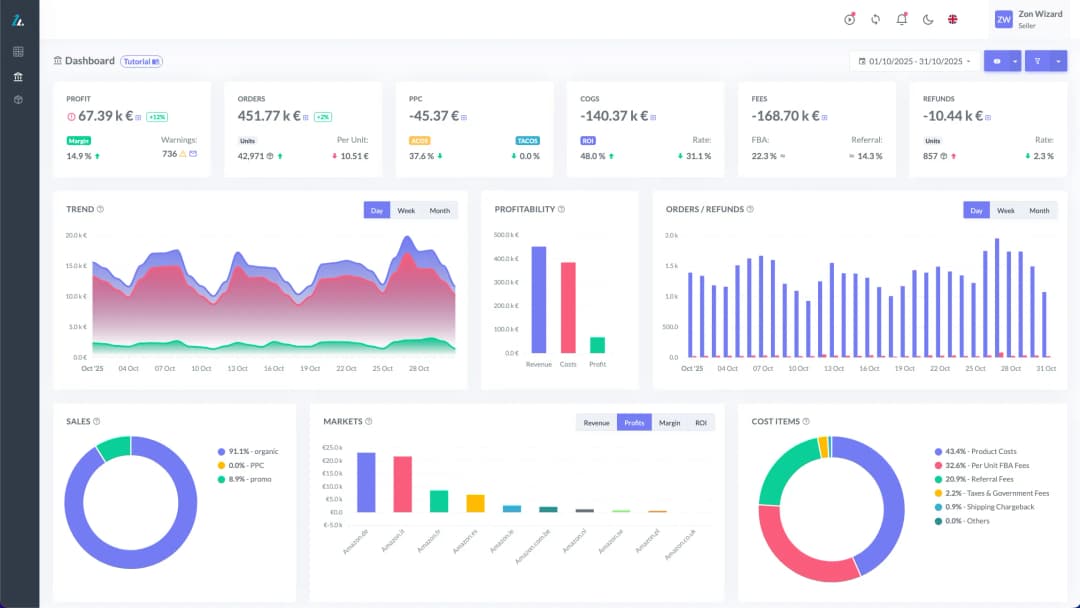
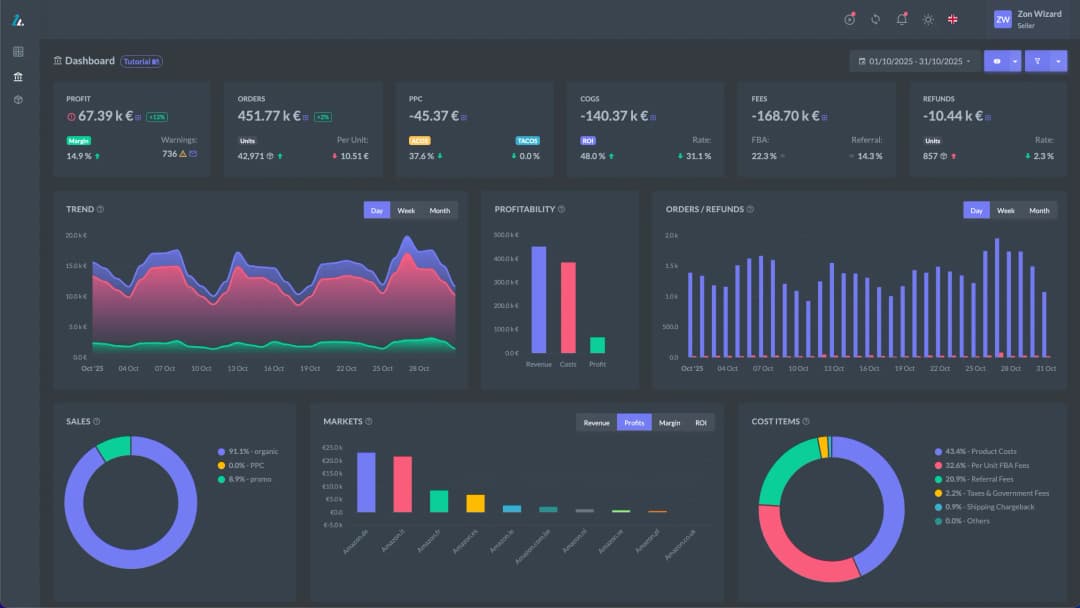
ZonWizard gives you a complete dashboard to monitor everything that matters: sales, margins, PPC and price trends. Designed specifically for Amazon sellers, ZonWizard lets you make decisions based on concrete data, not mere perceptions.
Know your real Amazon profit
Track margins, fees and net profit in one clear dashboard with ZonWizard.
Learn MoreLoading…

Amazon translates product images with AI: what changes for international sellers
Amazon has recently rolled out a feature many international sellers had been waiting for: automatic translation of the text inside product images. Thanks to artificial intelligence, the text overlaid on images (from size charts to technical specs, from feature callouts to comparison infographics) is now translated automatically into the customer’s language, without the seller having…
September 1st, 2026

Amazon Port 2026: all the news from the Cannes Festival and what changes for those who sell on Amazon
Every year the Cannes Festival of Creativity also becomes the showcase where Amazon Ads reveals where it is taking advertising on its own platform. In the 2026 edition, Amazon Port certainly did not disappoint expectations. And, as was to be expected, the event had a single common thread: artificial intelligence. Let’s look point by point…
July 9th, 2026
Ready to transform your business?
Start your free 30-day trial today, setup takes just a few minutes. No credit card required, cancel anytime.