

Amazon Auto Buy: the new button that is changing the rules of pricing for sellers
Amazon has been introducing one of the most significant changes to product detail pages for some time now. Called Auto Buy, it allows shoppers to set a target price and delegate to Amazon the automatic completion of the order as soon as that price is reached.
This is a truly interesting change and all sellers should understand clearly that it could partly modify how conversions happen on the marketplace. Let’s find out more!
Subscribe to Newsletter
Articles, mini-guides and updates on Amazon world from leading insiders.
How the Auto Buy button works
Auto Buy is fairly simple to understand. From the product page, a shopper can set a price threshold and authorise Amazon to complete the purchase automatically when that condition is met, using the default payment method and shipping address.
The feature can be activated in three ways:
- through the Set price alert button in the Amazon app
- through the Rufus AI assistant in conversational mode
- through voice commands on Alexa+.
There are, however, some conditions to keep in mind. First, the feature is currently available only for Prime customers in the United States. Furthermore, it applies exclusively to Fulfilled by Amazon (FBA) items. Finally, it requires a saved payment method and an active shipping address.
Each customer can have only one active request per product, limited to one unit per order. Once the automatic purchase is completed, the customer receives a notification and has a 24-hour window to cancel before the shipment is dispatched.
It should also be noted that promotional discounts and coupons do not apply to Auto Buy orders. The system therefore works exclusively on the base price of the product.
Also read our article Amazon Quarterly Earnings, Prime Day and More: the 2026 Calendar for Sellers and Vendors
The rollout is underway
In this scenario, we can’t help but notice that Amazon is introducing this new feature with very little public communication compared to other updates of equal importance. There is no significant marketing campaign, no prominent official announcement. Rather, it seems that Amazon wants to integrate the feature progressively into the experience of Rufus and the app, almost as if it were testing market response before promoting it on a large scale.
The introduction of this feature is, however, very consistent with the approach Amazon has taken, gradually shifting its model towards an agentic shopping experience, where AI acts on behalf of the customer without them having to actively return to the marketplace. In this sense, Auto Buy is one of the most visible pieces of this strategy.
Also read our article What is ROI and how is it calculated?
Rufus will become an autonomous source of conversions
It is worth sharing at this point how Auto Buy is unlikely to remain an isolated feature. Rather, it should be read within the overall growth of Rufus as a key tool in the Amazon shopping experience.
The numbers shared by Amazon itself speak clearly. In 2025, Rufus reached 300 million users, with monthly active user growth of 115% year over year and a 400% increase in engagement. Products presented by Rufus show a conversion rate 60% higher than the average. The estimated impact on annual sales approaches $12 billion.
In short, Rufus is certainly not a side experiment. It has instead become one of the main touchpoints through which Amazon customers discover, evaluate, and purchase products. And Auto Buy takes this logic a step further — and a more sophisticated one — transforming Rufus from a shopping advisor into an autonomous shopping agent.
In some respects, new objectives open up for sellers. Their listings must not only convince a human at the moment of visiting the product page. They must also intercept and satisfy the conditions set by shoppers who may have visited that page days or weeks earlier.
Are you really making a profit?
See your true net margin on every order with ZonWizard's profit analytics.
Learn MoreThe concrete implications for pricing strategy
We come now to the element most affected by Auto Buy: pricing strategies. Below we have shared some insights to help manage the relationship between price and conversion more effectively.
Price is no longer just a perceived value signal
Traditionally, lowering the price served to make a product more attractive to an undecided customer. With Auto Buy, lowering the price can automatically trigger a series of orders from customers who had already expressed a conditional purchase intent. A repricing operation no longer only affects future visitors. Potentially, it can also affect a queue of buyers already “waiting”.
The time window for conversion becomes longer
A customer who sets an Auto Buy on a product is essentially expressing a purchase intent that is recorded in the system. That intent can convert into an order days, weeks or months after the initial visit to the product page.
It follows that it becomes much harder to interpret traditional conversion metrics. A visit that does not convert immediately could still generate a future purchase through the automatic mechanism.
Dynamic repricing becomes more delicate
Sellers who use automatic repricing tools to compete on price must take into account that every price reduction, even a temporary one, could activate Auto Buy orders that were in the queue. If a downward repricing operation was planned only for a limited promotional period, it could generate unexpected demand that exceeds stock expectations or overlaps with a window in which higher margins were preferred.
FBA products have an advantage in this context
Since Auto Buy is available only for Amazon-fulfilled products, sellers who rely on FBA find themselves in an advantaged position compared to those using FBM (Fulfilled by Merchant).
This is a further incentive to carefully evaluate one’s sales logistics. In particular, for products with high potential for repeat purchases.
Coupons and promotions are not counted
If your promotional strategy relies heavily on coupons or flash deals, these will not trigger Auto Buy orders. The system works exclusively on the base price. To activate that potential queued demand, the actual product price must drop below the threshold set by the customer.
Also read our article FBA or FBM: how to calculate the optimal stock level
How to adapt your strategy to the new scenario
In a context that is changing in the way described above, actively adapting one’s strategy makes it possible to maintain or gain ground in consumer choices.
Below we summarise some lines of approach:
- Revisit your repricing strategy in light of this new variable. If you use an automatic repricing tool, check how it manages temporary price reductions and consider setting minimum price thresholds that account for the possible triggering of Auto Buy orders.
- Analyse the history of your prices. With price history now visible to customers through Rufus, and with Auto Buy responding to price movements in real time, having a clear picture of how your price has changed over time becomes essential to understanding how customers perceive you and when they set their thresholds.
- Monitor conversions with greater time granularity. If conversions can occur days or weeks after the initial visit, standard attribution windows may not capture the full effect of your pricing actions. Tracking sales in relation to price changes over time will give you a more precise picture.
- Consider optimising towards FBA if you haven’t already. For products where you are still on FBM, evaluate whether switching to FBA (or at least a hybrid approach) could open access to features like Auto Buy that explicitly exclude products not managed by Amazon.
You can also read our article Amazon Inventory Management: best practices for replenishment, stock and fees
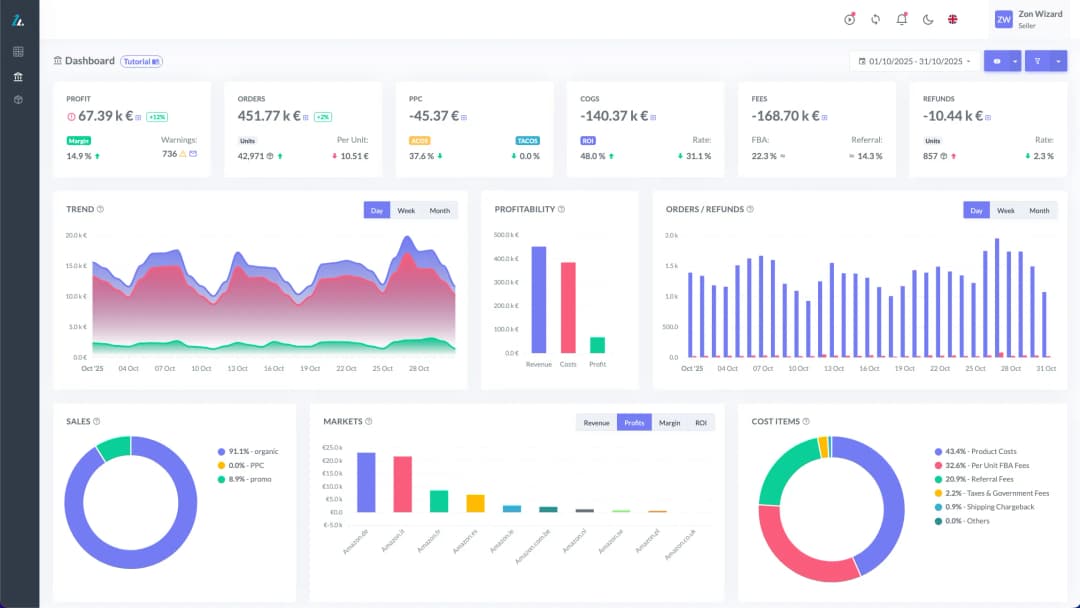
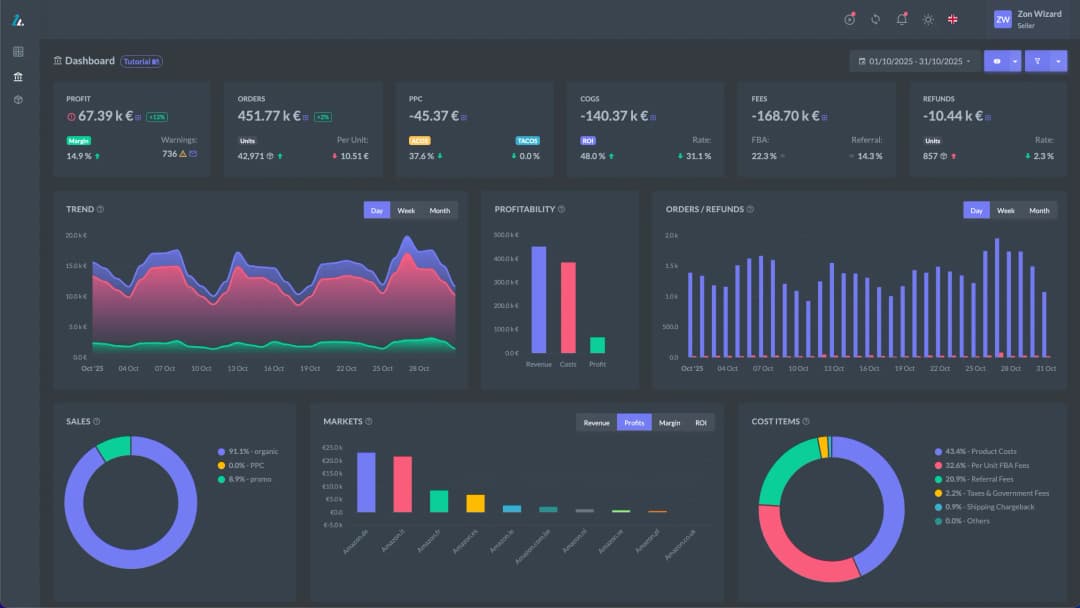
ZonWizard: keep control of pricing and margins in a marketplace that is automating itself
In a scenario where conversions can happen automatically and price changes have immediate and cascading effects, having a clear, real-time view of your performance is increasingly important.
With ZonWizard you can
- monitor the price trends of your products
- analyse real margins taking into account all Amazon costs
- make pricing decisions based on concrete, timely and up-to-date data.
👉 Discover ZonWizard HERE: free trial available!
Know your real Amazon profit
Track margins, fees and net profit in one clear dashboard with ZonWizard.
Learn MoreLoading…

Amazon translates product images with AI: what changes for international sellers
Amazon has recently rolled out a feature many international sellers had been waiting for: automatic translation of the text inside product images. Thanks to artificial intelligence, the text overlaid on images (from size charts to technical specs, from feature callouts to comparison infographics) is now translated automatically into the customer’s language, without the seller having…
September 1st, 2026

Why Amazon sometimes deletes listings: what causes it and how to act
If you sell on Amazon, you may already have been through this unpleasant surprise. You open your inventory management page, and one of your listings is gone. No warning, no email, just the feeling of having lost sales, organic ranking and months of work in a matter of minutes. There is good news, though. In…
September 1st, 2026
Ready to transform your business?
Start your free 30-day trial today, setup takes just a few minutes. No credit card required, cancel anytime.