

WooCommerce vs Amazon: two complementary strategies for the success of your online business
Those who have a business on electronic commerce, often wonder if it is better to manage their own store on WooCommerce or on Amazon. Is there really a winner between the two alternatives?
In truth, the choice between WooCommerce and Amazon should not be seen as an exclusive alternative. Rather, as two complementary approaches to online selling.
Both platforms offer indeed distinct advantages. And, when used well together, they can significantly amplify the growth potential of a business activity.
That is why at ZonWizard we have chosen to bring some innovations, integrating into WooCommerce some of our best tools.
Subscribe to Newsletter
Articles, mini-guides and updates on Amazon world from leading insiders.
Amazon remains the international showcase par excellence
Let’s start from the basics. As known, Amazon is the largest marketplace in the world with over 300 million active customers. The strength of this platform is definitely its ability to offer immediate visibility to any seller, regardless of the size of the company.
When an entrepreneur uploads their products to Amazon, therefore, they automatically come into contact with an audience already predisposed to purchase, which visits the platform with the specific intention of buying.
Not only that. let’s always remember that the sales system on Amazon is built on trust consolidated over time. Consumers who operate on Amazon feel protected
- from return policies
- from efficient customer service
- from the A-Z guarantee that covers every transaction.
In short, a level of reliability has been created that translates into generally higher conversion rates compared to independent stores. Especially, we add, if operating with little-known brands that are taking their first steps in online commerce.
Logistics is another essential point of strength. The Fulfillment by Amazon (FBA) service eliminates any complexity in the management of shipments. It allows sellers to focus on product development and commercial strategy.
FBA products are stored in Amazon distribution centers, prepared and shipped with the speed that consumers expect, often with 24-hour delivery for Prime members.
>>> You can also read our article Amazon intensifies the war against fake reviews: legal actions and AI technology <<<
WooCommerce is your tailor-made digital store
Compared to Amazon, WooCommerce adopts a different approach, based on independence and total customization. Being an open-source plugin for WordPress, in fact, it offers sellers the possibility to build a completely personalized online store. Every element of the purchasing experience can therefore be modeled according to the brand’s vision.
Another advantage is linked to data ownership. With WooCommerce, in fact, every piece of information about customers, from purchasing preferences to browsing behaviors, belongs exclusively to the store owner. Data like these are a valuable asset to develop
- targeted marketing strategies
- personalized loyalty programs
- better understanding of one’s target audience.
From the economic point of view, WooCommerce eliminates the commissions on sales that characterize marketplaces. Although there are costs for hosting, the domain and for premium extensions, they are generally lower than the percentages that Amazon withholds on every transaction, which can fluctuate between 15% and 45% depending on the product category.
>>> You can also read our article Amazon Inventory Management: best practices for replenishment, stock and fees <<<
Why using both platforms is convenient
At this point it is easy to understand why it is not possible to choose a favorite between the two options. Rather, the true convenience lies in recognizing that Amazon and WooCommerce serve different but complementary objectives within an omni-channel sales strategy.
Amazon excels in fact in the acquisition of new customers and in the generation of rapid sales volumes. WooCommerce allows for building long-lasting relationships with customers and maximizing brand value in the long term.
Using Amazon as an acquisition channel, companies can intercept consumers who would have never discovered the brand through other channels. Once these customers have tried the product and developed trust in the brand through the experience on Amazon, they could lead themselves spontaneously towards the WooCommerce store.
One’s own store can therefore become the nerve center of the relationship with the customer. Here it will be possible for example to offer
- exclusive products
- personalized bundles
- premium content
- a purchasing experience that fully reflects the brand’s values.
The higher profit margins obtainable on WooCommerce compensate for the marketing investments necessary to attract traffic towards the proprietary site.
>>> Read also our guide Amazon inventory management: guide to warehouse optimization <<<
Tax management and technological integration
One of the main challenges in the simultaneous management of multiple sales channels concerns the harmonization of administrative and tax processes. Selling on Amazon and through WooCommerce means managing two separate flows of transactions, with different implications in terms of invoicing, VAT management and tax reporting.
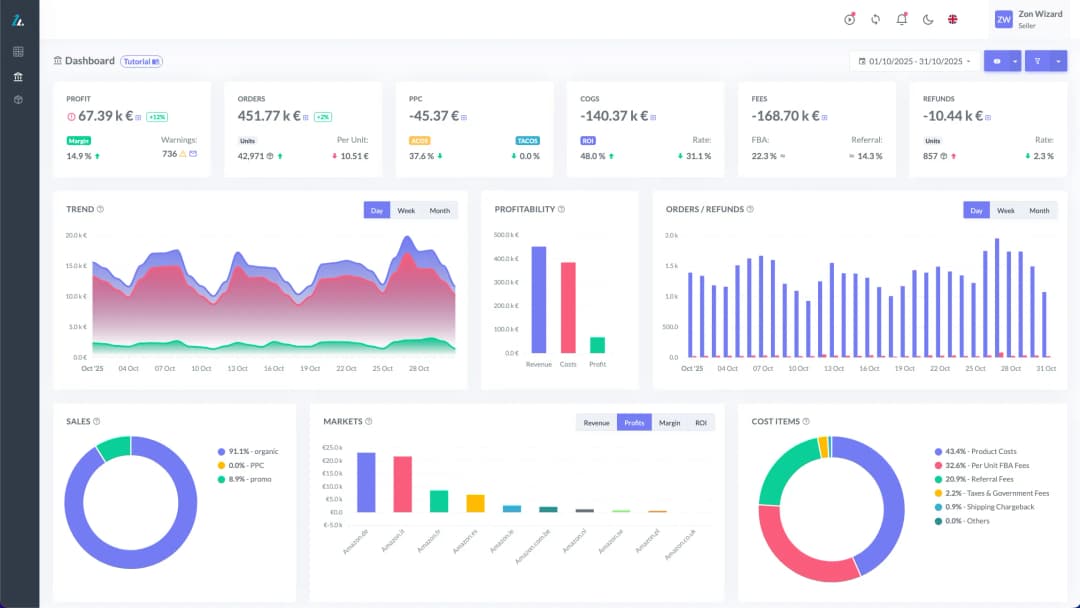
Precisely for this reason at ZonWizard we have developed specific integration solutions for WooCommerce that significantly simplify this complexity. Integrations can facilitate the overall tax management and the analysis of profitability per channel. A type of automation that becomes essential when scaling the business, allowing to maintain operational control without proportionally multiplying the administrative load.
Are you really making a profit?
See your true net margin on every order with ZonWizard's profit analytics.
Learn MoreThe brand construction
At this point we can go a bit further and try to outline some other important differences between the two channels.
For example, Amazon is truly excellent for testing new products quickly and validating market demand. The speed with which it is possible to launch a product and obtain feedback from the first buyers is incomparable. However, the construction of a strongly recognizable brand on Amazon is difficult due to the standardization of product listings and the presence of competitors on the same page.
WooCommerce, on the contrary, offers a white canvas to express the identity of the brand in every aspect. From the design of the site to the narration of the product, from the checkout experience to the blog contents, every element can be orchestrated to build an emotional connection with the customer. In short, there is a creative freedom available that is fundamental for brands that aspire to differentiate themselves through values, storytelling or a premium positioning.
Data analysis and continuous optimization
The integration of advanced analytics is a further advantage of a multi-channel strategy. Sales data on Amazon provide in fact precious information on market trends, on the best performing keywords and on the purchasing behavior of a vast audience of consumers. Information that can be used to optimize marketing campaigns on WooCommerce and to refine product descriptions.
Conversely, the analytics tools available for WooCommerce offer a much higher granularity in the analysis of the customer journey. It is possible to map exactly how visitors navigate the site, what contents they consult before buying, where they abandon the cart and much more. A depth of analysis that allows continuous iterations of the user experience based on concrete data.
>>> Read also our article Returns on Amazon are on the rise: what can we do? <<<
Adopting an integrated sales strategy
Everything above considered, it is fair to state that the future of electronic commerce belongs to those who will know how to intelligently manage different channels, recognizing the specific strengths of each platform.
Amazon and WooCommerce are not competitors in a brand’s strategy, but different tools with complementary purposes. The first to maximize reach and volume. The second to build brand value and long-lasting relationships.
Evidently, this integrated strategy requires planning, technological investments to synchronize systems and a clear understanding of commercial objectives. However, the brands that focus with more determination on it can position themselves more optimally to grow sustainably, diversifying risks and maximizing the opportunities offered by the contemporary digital landscape.
Are you really making a profit?
See your true net margin on every order with ZonWizard's profit analytics.
Learn MoreLoading…

Selling with PrestaShop: an introductory guide for those starting from scratch
When people decide to open an online store, the names that come up most often are usually Amazon and Shopify. But there is another route, one geared towards full control of your own store: PrestaShop. PrestaShop is in fact one of the most widely used e-commerce platforms in Europe, chosen by hundreds of thousands of…
October 6th, 2026

Selling on multiple channels profitably: the practical guide to getting started!
Selling only on Amazon is a great starting point, but today most sellers who really want to grow are looking at multichannel selling: eBay, Shopify, WooCommerce, PrestaShop, and perhaps several Amazon marketplaces at once. The potential is huge. More channels mean more customers reached, less dependence on a single algorithm and steadier revenue.
October 6th, 2026
Ready to transform your business?
Start your free 30-day trial today, setup takes just a few minutes. No credit card required, cancel anytime.