

Physical recovery: the 3 products that will explode on Amazon in 2026!
Physical recovery is certainly one of the most promising trends of 2026 for European Amazon sellers. Analyzing market data, Google Trends, and e-commerce platforms, we have identified three high-potential products.
In the following lines, we will see together what they are and why these products represent a concrete opportunity, with statistical data, profit margins, and specific strategies for the European market.
Let’s start!
Subscribe to Newsletter
Articles, mini-guides and updates on Amazon world from leading insiders.
The physical recovery market in Europe is a gold mine
Before getting into the details of individual products, it is useful to understand the size and potential of the physical recovery market in Europe.
The global massage equipment market was, for example, valued at $11.60 billion in 2024 and is expected to reach $21.76 billion by 2033, growing at a CAGR of 7.3% according to the latest findings by Grand View Research. Europe holds a significant slice of this market. It accounts for 21.4% of the global share.
But the numbers are even more interesting when we look at individual segments. The portable massager market is expected to grow at a faster CAGR (8.2%) from 2025 to 2033, driven by increased awareness of self-care and muscle recovery at home.
There are no major doubts as to why Europe is so attractive for these products. The macro-area benefits from a very consolidated wellness industry, a growing elderly population seeking pain relief, and an increasing number of athletes and fitness enthusiasts.
>>> Read also our article How can Amazon sellers react to US tariffs? <<<
Massage guns

Massage guns have gone from niche tools for professional athletes to must-haves for anyone who works out or suffers from muscle tension.
Their global market was, for example, valued between $500 million and $680 million in 2024, with projections indicating growth up to $917 million – $3.7 billion by 2030-2035, with a consequent CAGR ranging between 7.4% and 10.1% depending on the sources.
As for Europe, the market is the second-largest region after North America, with a share of about 32% of the global market according to Cognitive Market Research. Germany, the United Kingdom, and France are the most relevant markets.
The best news for Amazon sellers comes from profit margins. Production costs for a basic massage gun start at €15-25 in China, while sales prices on Amazon range between €80-250 depending on features. In short, potential gross margins of 400-600% before fees and advertising costs. For premium models with smart functions, pressure sensors, and long-life batteries, prices can exceed €300, with production costs around €40-50.
>>> Read also our guide Amazon inventory management: warehouse optimization guide <<<
Foam roller

Foam rollers are simple but effective tools for myofascial release. It is therefore not surprising that the market is experiencing an interesting evolution towards advanced technological models. Their global market is valued at $310-358 million in 2024 and is expected to reach $709-905 million by 2032-2033, with a CAGR varying between 7.2% and 11.1%.
In Europe, the market is worth about $77.6 million in 2024 according to Growth Market Reports, equal to about 22-30% of the global market depending on the surveys. Germany alone is worth $34.6 million with expected growth to $47.8 million by 2030.
Are you really making a profit?
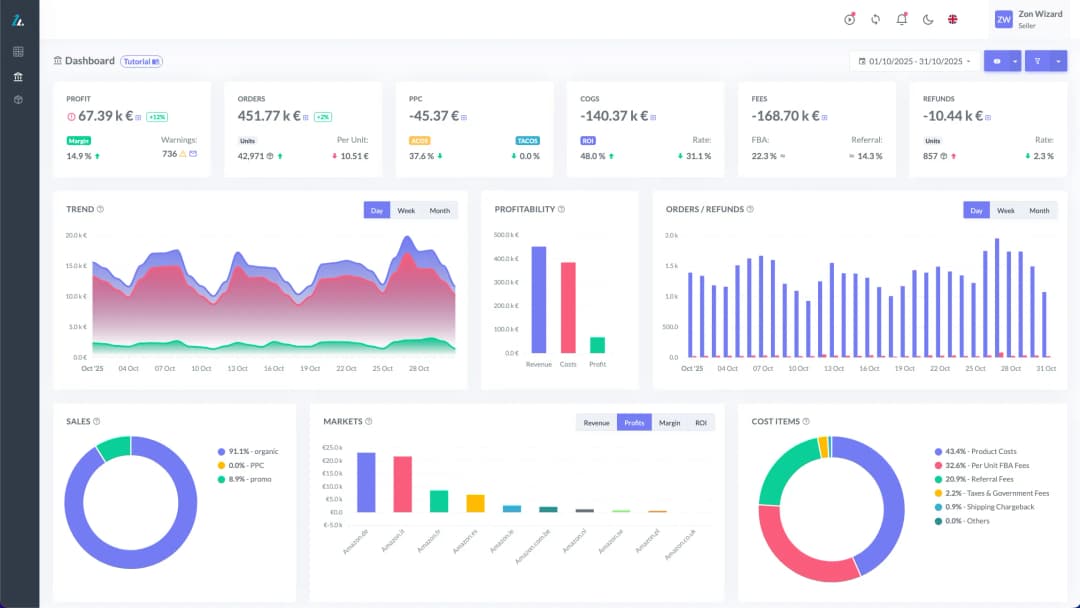
See your true net margin on every order with ZonWizard's profit analytics.
Learn MoreConsider also that the market is segmenting into three main categories:
- Traditional foam rollers (68% of the market): solid cylinders in EVA or EPP, sold between €15-35
- Textured foam rollers (29% of the market): with grated or knobby surfaces for deeper massages, sold between €25-50
- Vibrating foam rollers (24% of the market growing): with integrated vibration technology, sold between €80-150.
In all three cases, profit margins are significant. In the case of basic foam rollers, the production cost is about €3-6, with a sales price of €15-35 and a gross margin of 300-500%. In the case of textured foam rollers, the production cost is between €6 and €10, with a sales price of €25-50 and a gross margin of 250-400%. Finally, in the case of vibrating foam rollers, the production cost is €20-30, with a sales price of €80-150 and a gross margin of 300-500%.
>>> You can also read our article Amazon intensifies the war against fake reviews: legal actions and AI technology <<<
Muscle recovery creams

Pain relief creams are a huge and growing market. Topical application products, perfect for being sold as a complement to recovery equipment.
The global market has numbers that do not disappoint expectations. It is in fact valued between $11.06 and $12.02 billion in 2024 and is expected to reach $18.4-22.66 billion by 2033-2034, with a CAGR between 5.2% and 7.3%. North America leads with about 40% of the global market. However, Europe demonstrates solid and steady growth.
Also in this case, it is worth sharing how muscle recovery creams have interesting margins. The production cost is €2-5 for a 100ml tube (ingredients + packaging), while the sales price on Amazon is €15-35. There is therefore a gross margin in stable triple digits.
>>> You can also read our article Reddit and AI Search: here is why Amazon sellers cannot do without this platform <<<
Our strategies to maximize profits
Below we have summarized some strategies for Amazon sellers who really want to maximize profits in this niche.
Create a range of solutions for muscle recovery
Do not sell single products. Instead, try to sell a complete line that includes
- massage gun (main product)
- vibrating foam roller (cross sell)
- set of 3 creams (pre-workout, post-workout, night)
- complementary accessories (resistance bands, massage balls)
Remember: customers who buy the entire ecosystem of products have an LTV (lifetime value) 4.2 times higher than those who buy a single product!
Push for subscription purchases
Amazon allows creating subscriptions for consumable products. Creams are perfect for this:
- offer a 15% discount for the monthly subscription
- 23% of consumers who try the subscription keep it for at least 6 months
- MRR (monthly recurring revenue) stabilizes cash flow.
Create a content marketing strategy
Create a presence on different channels, such as:
- YouTube: Tutorials on the correct use of products (68% of buyers watch videos before buying)
- Instagram/TikTok: Before/after of athletes, recovery routines, testimonials
- SEO Blog: Guides like “How to recover from DOMS”, “Foam rolling for runners”, etc.
Content marketing reduces the average CPC (cost per click) of Amazon campaigns by 34%.
Consider expanding to other markets
Start with mature markets where demand is already high:
- Germany (largest market, customers willing to pay for quality)
- United Kingdom (strong fitness culture)
- France (consolidated wellness market)
Enter B2B as well as B2C
Do not limit yourself to end consumers. 25-27% of the foam roller market and 27% of the massage gun market is commercial use. Therefore contact:
- Gyms and CrossFit boxes
- Physiotherapy studios
- Hotels with SPAs
- Companies for employee wellness programs
- Amateur sports teams.
B2B sales have lower margins (20-25% vs 40-50% B2C) but much higher and predictable volumes.
> Read also our article FBA or FBM, how to calculate the optimal stock quantity <<<
Attention to obstacles to consider
As happens with every market, the physical recovery product market must also be evaluated with particular attention.
There is no shortage of risks and dangers, such as:
| Danger | Description | Solution |
| High competition | The massage gun market is dominated by established brands like Therabody and Hyperice. | Differentiate yourself in specific niches (e.g., “massage gun for amateur runners”, “post-cycling recovery”) rather than competing directly. |
| Low durability | 24% of foam roller users cite durability issues. 18% express price sensitivity for smart devices. | Offer an extended warranty (2 years instead of 1) and mention it among the main advantages. |
| Skin sensitivities | Creams can cause skin sensitivities, allergies, or irritation in some individuals, limiting their usability. | Always offer a “sensitive skin” version without perfumes and with hypoallergenic ingredients. Clearly indicate common allergens in the description. |
| Poor product knowledge | Many consumers do not know how to use foam rollers and massage guns correctly, leading to suboptimal results or potential injuries. | Invest heavily in educational content. Create a video series and link it from Amazon listings. |
| Competition with alternatives | Consumers have many alternatives: resistance bands, professional massages, heat/ice, TENS devices, etc. | Do not fight the alternatives. Position your products as “complementary” to other solutions. For example: “use this cream together with ice for even better results”. |
Good luck!
Are you really making a profit?
See your true net margin on every order with ZonWizard's profit analytics.
Learn MoreLoading…

Selling with PrestaShop: an introductory guide for those starting from scratch
When people decide to open an online store, the names that come up most often are usually Amazon and Shopify. But there is another route, one geared towards full control of your own store: PrestaShop. PrestaShop is in fact one of the most widely used e-commerce platforms in Europe, chosen by hundreds of thousands of…
October 6th, 2026

Selling on multiple channels profitably: the practical guide to getting started!
Selling only on Amazon is a great starting point, but today most sellers who really want to grow are looking at multichannel selling: eBay, Shopify, WooCommerce, PrestaShop, and perhaps several Amazon marketplaces at once. The potential is huge. More channels mean more customers reached, less dependence on a single algorithm and steadier revenue.
October 6th, 2026
Ready to transform your business?
Start your free 30-day trial today, setup takes just a few minutes. No credit card required, cancel anytime.