

Meta Ads, all the opportunities for Amazon sellers
When you think of advertising for Amazon, Sponsored Products or at most Google Ads probably come to mind. But there is a channel that too many sellers completely ignore: Meta Ads.
Yet, we are talking about a platform with over 3 billion active users, surgical targeting capabilities, and costs often lower than Google.
Not only that. For an Amazon seller, this tool can yield very important results for building demand, not just intercepting it. While Google captures those already searching, Facebook allows you to show your products to people who didn’t even know they needed them.
Subscribe to Newsletter
Articles, mini-guides and updates on Amazon world from leading insiders.
The product catalog is the starting point of the Facebook strategy
Let’s go in order. If you sell on Amazon, you already have a product catalog. What you need to do is synchronize it with Facebook via Business Manager. Once the catalog is configured, you can launch Dynamic Ads, which automatically show the right products to the right people.
Dynamic Product Ads (DPA) are the most powerful format for sellers. They work like intelligent remarketing: if a user visits your Amazon listing but doesn’t buy, Facebook shows them exactly that product while they scroll through their feed. The conversion rate of these campaigns is significantly higher than static ads.
The configuration requires a Facebook pixel installed on your site (if you have one) or the use of tracking links to Amazon. It is not immediate, but once the system is set up, it practically runs itself.
> Also read our article FBA or FBM, how to calculate the optimal stock quantity <<<
Campaign success depends on targeting
However, it is on targeting that Facebook likely reveals the most important added value compared to any other platform.
You can target users based on incredibly specific interests, purchasing behaviors, life events, and previous interactions. Selling baby products? You can show ads only to new parents in the first 6 weeks after birth.
Lookalike Audiences are very functional. You upload a list of your best customers and Facebook finds similar people. If you have 1,000 customers who bought your product, Facebook can find another 100,000 with similar characteristics.
A common mistake, however, is starting immediately with audiences that are too broad. It is better instead to start with narrow and hyper-targeted audiences, test what works, and then scale progressively.
Advertising formats: video, carousels and stories
Facebook offers a very diverse variety of formats. Short videos (15-30 seconds) that show the product in action, for example, convert excellently, especially for products that solve specific problems.
Carousels allow you to show multiple products or multiple angles of the same product in a single ad. They are perfect for bundles or for telling a story through sequential images.
Stories and Reels are becoming increasingly relevant, with costs per impression often lower than the traditional feed. They naturally require vertical and dynamic creatives. But if your product is very visual-friendly, they work great.
>>> You can also read our article Amazon intensifies the war against fake reviews: legal actions and AI technology <<<
Monitoring costs is the greatest difficulty
Meta Ads Manager overwhelms you with data, but the real problem is linking advertising spend to Amazon sales. Unlike Google, where the user clicks with purchase intent, on Facebook the path is indeed much more complex.
You must track not only clicks, but also conversion events on Amazon. How many people added to the cart? How many completed the purchase? What is the average time between click and purchase?
Without a robust tracking system, you find yourself spending thousands of dollars without knowing if they are bringing real sales or just useless traffic.
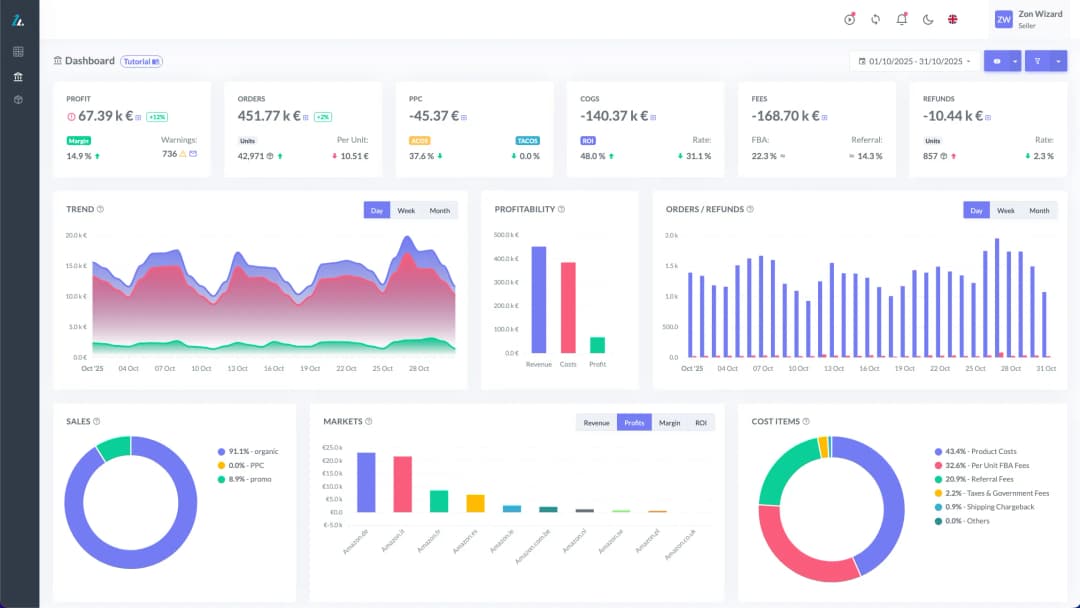
With the new functions of ZonWizard, the costs of your Ads campaigns are now detected directly by the software.
Are you really making a profit?
See your true net margin on every order with ZonWizard's profit analytics.
Learn MoreBest practices to avoid burning budget
With all that said, we wanted to share some tips that we think could be useful to avoid wasting budget unnecessarily.
First of all, creativity does 80% of the work. An ad with poor images or generic copy will never work, even with perfect targeting. Invest in professional photos, quality videos, and persuasive copy that talks about benefits, not features.
Second rule: test everything, always. Create at least 3-4 variations of each ad with different images, headlines, and copy. Facebook will tell you which one performs best, then deactivate the others and scale the winner.
Finally, do not ignore intermediate metrics. If the cost per click is high but the CTR (Click-Through Rate) is good, the problem is not the targeting but probably the landing page on Amazon. If the CTR is low, you need to improve the creatives.
Retargeting: the highest ROI you can obtain
Retargeting on Facebook is incredibly undervalued by Amazon sellers. Yet it costs relatively little, because you show ads only to those who have already interacted with you, and the conversion rate can reach 10-15% compared to 1-2% for cold campaigns.
You can retarget those who visited your listing but didn’t buy, those who follow you on Instagram, or those who interacted with your posts. You can also create retargeting sequences: first ad with a discount, second with enthusiastic reviews, third with urgency (limited stock).
The trick is not to be intrusive. Limit the frequency to 2-3 impressions per week per user, otherwise you become annoying and get the opposite effect.
>>> You can also read our article Amazon Inventory Management: best practices for replenishment, stock and fees <<<
Meta’s AI: automation that actually works
Meta has invested billions in artificial intelligence for advertising. Advantage+ campaigns use machine learning to automatically optimize budget, placement, audience, and creativity.
For Amazon sellers, this means you can set performance goals and let the algorithm do the heavy lifting. Meta’s AI is particularly good at finding users with high conversion potential that you would never have targeted manually.
But as with Google, the AI needs data to function. You need a minimum volume of conversions (at least 50 per week) for the algorithm to learn effectively. For this reason, at the beginning, you will have to do manual optimization.
>>> Also read our article What is ROI and how is it calculated? <<<
Control and reporting: from chaos to clarity
Meta Ads Manager can seem like a labyrinth. Metrics everywhere, complex dashboards, technical terminology. But in reality, it is good to approach it with pragmatism. The metrics that really matter, at least in the early stages, are indeed few:
- ROAS
- cost per purchase
- CTR
- frequency
- conversion rate.
The real problem is that Facebook tells you how much you spent and how many clicks you generated, but it doesn’t automatically know how many sales you made on Amazon. You need to build an attribution system that connects the two worlds.
Facebook vs Google: which to choose?
At this point, you might be wondering whether it is worth focusing on Meta Ads or Google Ads. Or, perhaps, which of the two platforms is better.
The answer might surprise you. It’s better to target both, but with different strategies. Google captures an existing demand (performance marketing). Facebook creates demand and builds brand awareness.
Know your real Amazon profit
Track margins, fees and net profit in one clear dashboard with ZonWizard.
Learn MoreLoading…

Selling with PrestaShop: an introductory guide for those starting from scratch
When people decide to open an online store, the names that come up most often are usually Amazon and Shopify. But there is another route, one geared towards full control of your own store: PrestaShop. PrestaShop is in fact one of the most widely used e-commerce platforms in Europe, chosen by hundreds of thousands of…
October 6th, 2026

Selling on multiple channels profitably: the practical guide to getting started!
Selling only on Amazon is a great starting point, but today most sellers who really want to grow are looking at multichannel selling: eBay, Shopify, WooCommerce, PrestaShop, and perhaps several Amazon marketplaces at once. The potential is huge. More channels mean more customers reached, less dependence on a single algorithm and steadier revenue.
October 6th, 2026
Ready to transform your business?
Start your free 30-day trial today, setup takes just a few minutes. No credit card required, cancel anytime.