

2026 holiday calendar: how to prepare and sell better on Amazon
The success of an Amazon seller depends also on their ability to plan and manage calendar holidays and the most important commercial events.
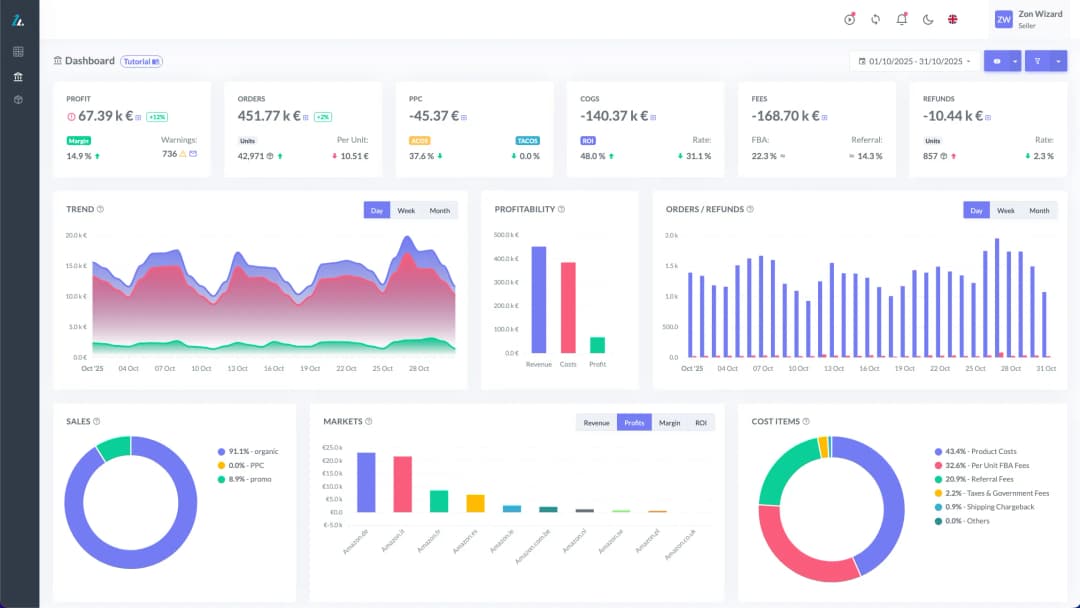
Considering that every Country has cultural and commercial specificities that require a customized approach, if you have decided to sell on multiple markets you cannot do without helping yourself with in-depth analyses of sales data and with the professional tools that you find here on ZonWizard.
To help you even more to better face this 2026 full of challenges, we have created a complete guide to the most relevant holidays. A specific focus on the main European markets, with many tips to sell more, and better.
Let’s start immediately!
Subscribe to Newsletter
Articles, mini-guides and updates on Amazon world from leading insiders.
Why it is important to understand the differences of European markets
Let’s start from the basics. The five main Amazon markets in Europe – Italy, Spain, France, Germany and United Kingdom – share some holidays but present also significant local peculiarities that influence purchasing behaviors.
Here, therefore, is that a seller who operates on multiple marketplaces must necessarily adapt their own strategy to such differences.
In Italy, for example, the Epiphany on January 6th constituted the natural closing of the Christmas period. Traditionally a sales peak is recorded for specific products like Befana stockings and traditional sweets. However, this event does not have the same weight in France, Germany or United Kingdom. Here, for example, the Boxing Day on December 26th inaugurates the winter sales period with completely different dynamics.
Let’s make some other examples. In Spain on March 19th is celebrated San José, the traditional Father’s Day. Sure, it exists also in Italy and on the same date. But here the occasion has very different connotations. In France and Germany, instead, Father’s Day is celebrated respectively in May and June.
In short, small examples that make us understand how these differences require distinct promotional planning for every market. Approaches impossible to manage effectively without an accurate preventive analysis.
Also religious holidays like Easter, while being common to all markets, present differentiated purchasing traditions. In Germany, Easter products start to be sought after weeks in advance compared to Italy or Spain. In the United Kingdom, instead, Good Friday and Easter Monday coincide with particularly exceptional online shopping occasions.

How important it is to help yourself with sales statistics
To successfully face European holidays, it is fundamental to analyze the sales statistics available on Amazon. Seller Central offers numerous reports that allow to identify seasonal patterns, demand peaks and product performance during specific periods of the year.
There are however some data that we believe are more important than others.
Let’s try to summarize them in this list:
-
sell-through rate (sales rate compared to available stock): particularly useful to understand which products have performed better during past holidays. Analyzing these data, a seller can identify which items deserve greater investments in terms of stock and promotions for future holidays;
-
conversion rate: reveal if the product pages are optimized to convert the greater traffic that characterizes these moments. A conversion rate lower than average during Valentine’s Day, for example, could indicate the necessity to improve images, titles or descriptions with a more romantic and gift-oriented focus;
-
advertising performance (ACoS, ROAS, CTR): are essential for planning promotional budgets. Typically, during events like Black Friday or the pre-Christmas period, the cost per click increases significantly due to greater competition. There is therefore a need for more sophisticated bidding strategies;
-
organic vs sponsored traffic: helps to understand if products benefit from natural seasonal searches or if they depend mainly on advertising campaigns. A very useful distinction to optimize the allocation of the marketing budget and maximize the ROI.
> Read also our article FBA or FBM, how to calculate the optimal stock quantity <<<
ZonWizard is by your side to help you sell better
Even if Amazon Seller Central is able to provide historical data on performance, tools like those you can find on ZonWizard offer better visibility on the overall market and on competitors, allowing more informed strategic decisions for European holidays.
ZonWizard allows you for example to analyze category sales trends during specific holiday periods. You will thus be able to discover in a few moments when the peak demand actually starts for certain types of products. For example, you might discover that in Germany the search for Christmas decorations starts already at the end of October. In Italy it concentrates more in November and December. You will thus be able to plan differentiated promotional timings.
The competitor monitoring functionality is even more central during holidays. Observing how the main sellers of the sector manage prices, promotions and stock availability during events like Black Friday provides strategic clues to position oneself competitively without compromising margins.
Also seasonal keyword analyses can give you great added values. They reveal indeed which search terms increase in volume during specific holidays. Information that is fundamental to optimize listings and advertising campaigns. During Valentine’s Day, for example, keywords like “gift for her” or “romantic surprise” see huge search increases that can be well exploited.
We remind you in this regard that our tools allow you to estimate future demand basing on aggregated market historical data and not only on your own past sales. A particularly useful contribution for new sellers or for those launching unpublished products, providing reliable sector benchmarks to plan stocks and promotional investments.

E-commerce Holiday Calendar 2026
All this premised, below we have summarized the calendar of 2026 holidays for the main Amazon markets.
| Date | Italy | Spain | France | Germany | United Kingdom | E-commerce Notes |
| Jan 1 | Capodanno | Año Nuevo | Jour de l’an | Neujahr | New Year’s Day | Post-winter sales |
| Jan 6 | Epifania | Reyes Magos | — | — | — | End of Christmas period IT/ES |
| Feb 14 | San Valentino | San Valentín | Saint-Valentin | Valentinstag | Valentine’s Day | Peak: jewelry, flowers, chocolate |
| Mar 19 | – | San José | — | — | — | Father’s Day ES |
| Apr 10 | Venerdì Santo | Viernes Santo | Vendredi Saint | Karfreitag | Good Friday | Pre-Easter: eggs, sweets |
| Apr 12 | Pasqua | Domingo de Pascua | Pâques | Ostersonntag | Easter Sunday | Easter Weekend |
| Apr 13 | Lunedì dell’Angelo | Lunes de Pascua | Lundi de Pâques | Ostermontag | Easter Monday | End of Easter weekend |
| Apr 25 | Liberazione | — | — | — | — | Italy Only |
| May 1 | Festa Lavoro | Día del Trabajo | Fête du Travail | Tag der Arbeit | Early May Bank Holiday | Long weekend |
| May 8 | — | — | Victoire 1945 | — | — | France Only |
| May 10 | — | — | — | — | — | Mother’s Day (IT/ES/FR/DE) |
| May 25 | — | — | — | — | Spring Bank Holiday | UK Only |
| Jun 2 | Festa Repubblica | — | — | — | — | Italy Only |
| Jun 21 | — | — | Fête Musique | — | — | Start of summer, summer sales |
| Aug 15 | Ferragosto | Asunción | Assomption | — | — | IT/ES/FR – Widespread closures |
| Aug 31 | — | — | — | — | Summer Bank Holiday | UK Only |
| Oct 12 | – | Fiesta Nacional | — | — | — | Spain Only |
| Nov 1 | Ognissanti | Todos los Santos | Toussaint | Allerheiligen | – | IT/ES/FR/DE |
| Nov 27 | Black Friday | Black Friday | Black Friday | Black Friday | Black Friday | MAIN EVENT |
| Nov 30 | Cyber Monday | Cyber Monday | Cyber Monday | Cyber Monday | Cyber Monday | ONLINE PEAK |
| Dec 6 | – | Constitución | — | — | — | Spain Only |
| Dec 8 | Immacolata | Inmaculada | — | — | — | IT/ES – Start of Xmas shopping |
| Dec 25 | Natale | Navidad | Noël | Weihnachten | Christmas Day | TOTAL CLOSURES |
| Dec 26 | Santo Stefano | — | — | 2. Weihnachtstag | Boxing Day | IT/DE/UK – Sales start |
How to prepare for calendar holidays
As is evident from the calendar shared above, Black Friday and Cyber Monday are the most important commercial events of the year for Amazon sellers in Europe. For these events, preparation must start at least three months before, with an in-depth analysis of the performance of the previous year and of current competition.
The increase in stocks for Black Friday requires indeed precise calculations based on historical data. Ordering too much carries risks of unsold goods and storage costs. Conversely, ordering too little means losing sales in the most profitable moment of the year. ZonWizard’s data on market demand estimates allow to calibrate orders with greater accuracy compared to the sole analysis of past sales.
Also advertising campaigns for Black Friday should be structured well in advance. You will thus be able to create effective differentiated audience segments and test creative messages several weeks before. Amazon offers special advertising formats during this period, like Sponsored Brands video and Display ads. Both require professional creative contents prepared in advance.
Are you really making a profit?
See your true net margin on every order with ZonWizard's profit analytics.
Learn MoreLogistics
The Christmas period, which in Europe extends substantially from the beginning of December until Epiphany in Italy and Spain, requires a truly impeccable logistics management. The cut-offs for guaranteed shipments before Christmas vary by country but generally fall between December 18 and 20. Communicating clearly these dates to customers through banners on product pages and post-purchase messages reduces complaints and negative reviews.
Valentine’s Day is instead a particular opportunity for specific categories like jewelry, perfumes, chocolates and beauty products. Preparation should start at the end of January. It is here that you will have the possibility to optimize product pages in a gift-friendly key and create specific bundles. With ZonWizard you will be able to identify which product combinations have performed best in the category during previous Valentine’s Days.
Easter presents a variable appointment every year and requires particular attention to the calendar. In 2026 it falls relatively early. You will therefore have to prepare already from the beginning of March.
>>> You can also read our article Amazon intensifies the war against fake reviews: legal actions and AI technology <<<
Management of local holidays and national specificities
The specific holidays of every Country are commercial opportunities often undervalued by pan-European sellers. Instead, dedicating attention to these local occasions allows to differentiate oneself from the competition and build stronger connections with local customers.
Italy
In Italy, April 25 (Liberation Day) and June 2 (Republic Day) often create longer bridges that influence both purchasing behaviors and logistical operations. Many Italians plan short vacations in these periods. Thus increases the demand for travel, outdoor and portable technology products. Analyzing these patterns through historical sales data allows to prepare targeted promotions.
Ferragosto (August 15) is another particular challenge for sellers operating in Italy, Spain and France. The period sees significant slowdowns in logistical operations and customer service. Many companies are closed for holidays. Planning adequate stocks and communicating clearly any delays in shipments becomes essential to maintain positive performance metrics.
>>> Read also our article Returns on Amazon are on the rise: what can we do? <<<
Spain
In Spain, holidays like San José (March 19), the Fiesta Nacional (October 12) and the Constitución (December 6) are relevant moments for localized promotions. Sellers who invest in specific campaigns for these dates. And they do it usually with creative contents in authentic Spanish. Ideal for obtaining engagement rates significantly higher compared to more generic competitors.
United Kingdom
The United Kingdom presents a unique Bank Holidays structure. There is the Spring Bank Holiday (May 25) and the Summer Bank Holiday (August 31) that create online shopping peaks comparable to minor holidays in other Countries. In the longer weekends they see predictable traffic increases that can be capitalized with Lightning Deals promotions and temporary advertising budget increases.
>>> Read also our article Innovative packaging, from Amazon new solutions for the packaging of the future <<<
Germany
Germany celebrates the Tag der Einheit (October 3), German Unity Day, which falls strategically at the beginning of autumn, a period already naturally dynamic for e-commerce. Sellers who manage to combine promotions for this national holiday with the launch of autumn products can obtain particularly positive results in the German market.

How to optimize your operations during holiday periods
At this point it should be clear how operational management during holidays requires detailed planning and flexibility. The Amazon performance metrics become even more central in these periods. Moments of the year in which high volumes and increased customer expectations create greater pressures.
Inventory management must be based on reliable sales projections integrated with considerations on supplier lead times. During Q4, many suppliers are overloaded with orders and production times lengthen. Use ZonWizard data to estimate expected demand. And order with 8-12 weeks in advance to avoid stock-outs in crucial moments.
Daily monitoring of stock levels during high-intensity periods like Black Friday Week or the two pre-Christmas weeks is necessary. Amazon penalizes stock-outs with losses of organic ranking difficult to recover. Setting automatic alerts when inventory falls below critical thresholds allows timely interventions.
>>> You can also read our article Amazon Inventory Management: best practices for replenishment, stock and fees <<<
Pricing strategies
Also pricing strategies during holidays require a delicate balance between competitiveness and margins. Using intelligent repricing tools that consider not only competitor prices but also
- your own cost structure
- advertising performance
- margin goals
is crucial.
During Black Friday, lowering prices without strategy can completely erode profitability despite high volumes.
Let’s dwell then briefly on customer service management during holiday peaks, which requires significant enhancements of the team. The period between Black Friday and Christmas sees customer contact volumes increase by 200-300%. Preparing response templates for frequently asked questions, adequately training temporary staff and implementing effective ticketing systems prevents deterioration of customer satisfaction metrics.
Shipping strategies must be communicated clearly and respected scrupulously. During the pre-Christmas period, customers are particularly sensitive to delivery times. Using tracked shipping services, communicating proactively any delays and offering expedited shipping options when possible improves customer experience and protects performance metrics.
How to prepare holiday marketing campaigns
Marketing campaigns for holidays should be planned and prepared well in advance, ideally 6-8 weeks before the target event. In this way you will be able to
- test messages
- optimize creatives
- build qualified audiences before the peak of competition.
Let’s pass then to optimizations for listings. Titles that incorporate seasonal keywords like “perfect gift for Christmas” or “Valentine’s idea” can significantly improve organic visibility during relevant periods.
Regarding promotions, Amazon Sponsored Ads campaigns should be structured with separate budgets for holiday periods, allowing flexibility in resource allocation. During Black Friday, for example, CPCs can triple. Having dedicated budgets avoids that daily campaigns are exhausted prematurely. The use of dayparting (planning by time slots) further optimizes spending by concentrating the budget in moments of highest conversion.
>>>Read also our guide Amazon Inventory Management: guide to warehouse optimization <<<
How to perform post-holiday analysis
Commitments as a seller certainly do not end with the conclusion of the holidays. Indeed, it is fair to emphasize how the analysis of performance after every holiday is fundamental for continuous improvement. Immediately after major events like Black Friday or the Christmas period, therefore, dedicate time to the detailed analysis of what worked and what can be improved. You will thus have very useful clues for the following year.
Sell-through data during the holiday should for example be compared with initial projections. You will thus be able to evaluate the accuracy of planning. Products that sold much more than expected indicate greater investment opportunities. Products that disappointed require strategic revisions or potentially elimination from the future holiday catalog.
The analysis of post-holiday advertising metrics reveals instead which campaigns, keywords and formats generated the best ROI. These data should be documented systematically to inform next year’s strategies. Particularly precious is the analysis of the customer lifetime value of customers acquired during holidays. Acquiring customers with aggressive promotions makes sense only if they show propensity for repeat purchases.
Reviews and inventory
Reviews received in the post-holiday period require specific caution. Sales peaks often bring proportional increases in reviews. Actively managing negative feedback prevents damage to product reputation. Analyzing recurring patterns in holiday complaints allows to identify recurring problems to solve proactively for subsequent holidays.
Finally, dedicate time also to post-holiday inventory management. Strongly seasonal products remained unsold require rapid decisions. For example, liquidation through aggressive promotions, storage until the following year, or returns to suppliers if possible. Keeping capital tied up in seasonal inventory negatively impacts the liquidity available for new opportunities.
Do you want to optimize your performance during European holidays? Our team of experts can help you develop customized strategies for every market, making the most of the potential of professional tools like ZonWizard. Contact us and try our demos to find out more!
Are you really making a profit?
See your true net margin on every order with ZonWizard's profit analytics.
Learn MoreLoading…

Selling with PrestaShop: an introductory guide for those starting from scratch
When people decide to open an online store, the names that come up most often are usually Amazon and Shopify. But there is another route, one geared towards full control of your own store: PrestaShop. PrestaShop is in fact one of the most widely used e-commerce platforms in Europe, chosen by hundreds of thousands of…
October 6th, 2026

Selling on multiple channels profitably: the practical guide to getting started!
Selling only on Amazon is a great starting point, but today most sellers who really want to grow are looking at multichannel selling: eBay, Shopify, WooCommerce, PrestaShop, and perhaps several Amazon marketplaces at once. The potential is huge. More channels mean more customers reached, less dependence on a single algorithm and steadier revenue.
October 6th, 2026
Ready to transform your business?
Start your free 30-day trial today, setup takes just a few minutes. No credit card required, cancel anytime.